Joe Hendren

[ Home ] [ Articles ] [ Blog Home ] [ Travel ] [ Links] [About Me]

Tuesday, June 09, 2009

The legacy of neo-liberalism on family life - some thoughts from Blackball

I wrote most of the following post around three weeks ago, and was always intending to go back and finish it. I thought it might be an opportune time after seeing a related item on the news tonight.

A neonatal paediatrician is warning parents to do all they can to avoid putting their young children in daycare, saying it could permanently harm their developing brains. Dr Simon Rowley advocates for a parent to stay home with children in the early years if they can. He cites research looking at the hormone cortisol that found 80% of children in daycare become more stressed during the day, with toddlers showing the highest levels of stress.

Early Childhood Council chief executive Sarah Farquhar has taken issue with Dr Rowley .
"It's going back to the times of women being barefoot and pregnant in the kitchen. That's not healthy for children and it's not healthy for women . . . making parents feel guilty about their choices is not the way to go."
The Early Childhood Council also happens to be protecting its market - as an organisation representing private childcare centres. Kids are their source of cash.

Now its possible that Dr Rowley is running a socially conservative agenda here, particularly when he blames the social policies of Helen Clark, and many social conservatives demonise Clark. Yet to leave the issue there I think does the left a disservice, as it may leave empty political ground for socially conservative politicians if the left is not seen to be engaging with the issues in a deeper way.

What got me thinking about this was a very interesting discussion during the Blackball May Day celebrations earlier this year. We looked at the legacy of neo-liberalism in New Zealand, with a focus on its affect on family life.

I am greatly thankful to my fellow participants for helping me think about the issues in new ways.
--
The Blackball Working Class History Project now has a blog.

This year I attended the May Day celebrations in Blackball. It was an enjoyable and engaging weekend. As 2008 was the 100th anniversary of the famous Blackball miners strike, the numbers were smaller in 2009, but this allowed the issues to be covered in greater depth.

On the Saturday morning a forum was held on The Legacy of Neo-Liberalism. Many people prepared provocations for the forum in order to start the discussion. Rather than focus on economics and the undemocratic nature of how neo-liberalism was forced on the electorate, many people spoke of the legacy of neo-liberalism on families and family life.

It is great to see many of these contributions from the forum now appearing online. Paul Manuder has written a rundown of the weekend. Sandra and others highlighted the punative attitude of many government departments.

"I’ve got a friend in Greymouth who cares for her baby granddaughter, her ten year old son and her suicidal adult son. Can someone tell me why this woman, this mother, grandmother, carer of our most vulnerable, is being badgered by WINZ to get paying employment?"

I believe part of the explanation for this lies with the Social Security Amendment Act passed by the last Labour Government. This Act changed the whole purpose of the Act famously passed by Michael Joseph Savage in 1938. Rather than a focus on the welfare of the community, the focus came on getting a job - any job - as the only legitimate form of social assistance. I suggested Savage would be turning in his grave if he knew about these changes.

To return to the focus on the impact of neo-liberalism on family life, it was interesting that many saw the lack of family time due to financial pressure as a key problem. For example, a local teacher, Te Whaea Ireland saw many children with a desperate need for one on one contact with adults. Sandra summarised Te Whaea's comments like this.

"Parents love their children but the children are stressed. Families are stressed through everyone working long hours to survive economically. Children are arriving at school earlier, then there’s after school care, there’s no adult with the time to help with homework, no time for mooching- that stress-free space which generates self management, relatedness, creativity etc. The family is no longer functioning as a nurturing unit. She saw among her peer group, the stress in terms of a young couple trying to acquire a home and to have a family. She saw the traditional homemaker, once gender equality is accepted, as a valid and vital role in society."


It ought to be stressed that Te Whaea was not advocating a socially conservative agenda, as she assumes the acceptance of gender equity. Freedom and equity should aim to give people greater choices. The issue is that due to financial pressure parents no longer have the choice whether they wish to work OR be a homemaker.

Essentially, over the past 50 years employers have used the rightful work aspirations of women to halve 'real' family incomes - double incomes are now required to raise families in most cases. The Employment Contracts Act made the situation worse. I do not wish to go back to the 1950s here - what I am highlighting is how New Zealand employers and their right wing friends have used this societal change to their own economic advantage.

In terms of policy responses the following might be a useful starting point. The challenge of the left is not only to announce such policies but to demonstrate how they are relevant to the issues currently facing families. I am not sure the left has done so yet, or as effectively as it might.
  • A new industrial relations framework which delivers a fairer share of company profits to families (the new Australian legislation might be worth looking at - particularly if we are serious about a real CER that is not limited to just what the business community wants)
  • A minimum wage set at two thirds of the average wage (sign the Unite petition)
  • Universal Basic Income (which would recognise the currently unpaid work of homemakers)
  • A year or more of paid parental leave.
  • More research on children's experiences on daycare - are there ways to make it less stressful and more confortable for the kids?
I very much welcome comments on this post, as I feel as if I am still working out the issues as I go.

--
During the Blackball forum I also suggested that the Clark Labour Government may be seen by future historians as playing a key role in embedding neo-liberalism as it deliberately avoided changing any of the neo-liberal legislation or the aggressive 'free trade' policies of the forth Labour Government. Despite the country voting left in 1999, the Reserve Bank Act, the Public Finance Act, the State Sector Act and a strict orthodoxy of 'balanced budgets' remained. Even after nine years. Indeed it is significant that in his valedictory speech the former Labour Finance Minister Michael Cullen spoke of his pride in pursuing free trade agreements and maintaining a socially progressive but fiscally conservative party.

I respected Cullen's intellect and his wit a great deal, but I always thought his views on the inevitability and the desirability of the WTO version of the global market were simply pollyanna. While he did renationalise the railways, this was only after costing the country millions by entering into a failed public-private partnership with Toll Holdings in 2004. In 2003 he had the opportunity buy the railways on the cheap and to tell Toll to noddy off, but did not do so.

Labels: , , , , ,

Wednesday, September 17, 2008

Mullings on pay equity

During the Inagural Suffrage Eve Debate I will be particularly interested in the debate over approaches to employment law.

In 2004 Dr Judy McGregor from the Human Rights Commission wrote an interesting submission on the proposed Employment Relations Law Reform Bill
"While there is not a consensus, most commentators, including the Ministry of Women’s Affairs, believe that New Zealand has not complied with its international obligations in relation to pay equity since 1990 when the short-lived Employment Equity Act (1990) was repealed. This omission is one element in the comprehensive legislative and policy framework needed to give effect to pay and employment equity. "

The Employment Equity Act, championed by Helen Clark, only had a short life. The removal of awards under the Employment Contracts Act effectively invalidated any positive impact the legislation may have had. Jobs that were traditionally dominated by female workers continue to be paid less than comparable jobs traditionally dominated by men.

I had a thought that horrified me a little today. Without going and ferreting out the figures, I would not be surprised if the significant increases in the minimum wage since 1999 have had a small positive impact on pay equity, as the lower wage bands flattened out to the new minimum. So to measure progress towards pay equity issue by itself, and to see the wonderous 'market' [cough][cough] at work it would make sense to exclude all minimum wages from the comparison. Not that I am immediately sure how to achieve this of course :)

In 2007 female full-time workers earned 14% less than men. The gender pay gap was 13% in the 2006 survey, and 16% in 2005.

This entails that if progress towards pay equity is to be achieved, we need to see greater progress further up the income scale. Given that the gender pay gap has now been with us for as long as women have been working, I doubt its going to be sorted by employers and employees negotiating among themselves. Pay equity will only be achieved as part of a more structured approach to employment relations, involving specific pay equity enabling legislation, ongoing research and a culture more conducive to collective bargaining.

Labels: , ,

Tuesday, June 03, 2008

Go Go Go Child Povery Action Group, Boo Labour

There was some good news on the box tonight. The Human Rights Review Tribunal has begun to hear the case bought against the Government by the Child Poverty Action Group that the Working for Families programme discriminates against the children of beneficiaries.

The case centres around the the In-Work tax credit, worth around $60 a week. The Labour-led Government excluded beneficiaries from being eligible for this payment. CPAG say this is illegal discrimination because it is Government assistance given only to a select group. 220,000 children from beneficiary families currently miss out.

The Working for Families policy assumes that parents use the money to help with the costs of raising families. How can it be fair that children of beneficiaries are denied $60 a week on the basis of the source of their parents income? Are the Labour party seeking to encourage a new pester power, as in Mummy why don't you get a job? How can it be fair that families lose the $60 a week when a parent has the misfortune to be made redundant?

Prime Minister Helen Clark attempts to defend Labour's policy by claiming Working for Families has lifted 130 thousand families out of poverty. Even though Working for Families has improved the lives of many families, New Zealand's child poverty figures would suggest Clark's claim is somewhat of an exaggeration. Particularly when the Working for Families policy deliberately excluded the very poorest - beneficiary families. Clark also claims "[s]ince the in-work payment came in for the first time we've got the numbers on domestic purposes benefit going down, thats a great thing because it means we have more children seeing their parents going to work everyday to earn a living." Now Helen, can you please tell me how this is the fault of the children?

This and other comments made at the time by of the introduction of Working for Families make it clear that a key policy objective of Working for Families was to increase the difference between the incomes of those on a benefit and those in (low) paid work. The same policy principle underlay Ruth Richardson's 'Mother of All Budgets' in 1991, where Ruth Richardson slashed benefits. Despite making many complaints about these cuts in opposition, Labour have never made any real effort to restore benefit levels in 9 years of Government. Labour ensured beneficiaries did not get any benefit from the tax cuts announced in the Budget, which will only make the situation worse.

The Government's own Ministry of Social Development now say beneficiaries are now worse off now than they were under National in the 1990s. With such a record Labour do not deserve the support of beneficiaries, but neither do National as they have said they are happy with benefit levels as they are now. In contrast, the Greens have given consistent support to beneficiaries in Parliament, despite a great many beneficiaries continuing to support Labour out of habit.

In her recent speech on the 2008 Budget Green MP Sue Bradford said
"..,Dr Cullen certainly has a different understanding of labour history in this country than I do. I had thought that the first Labour Government under Michael Joseph Savage swept to power in 1935 as a result of the mass unemployment and poverty suffered through six years of the Great Depression. It was unemployed workers together with their comrades still in work who helped create and drive the great things Labour did in those early days, including taking the first steps towards getting a decent welfare system into place, and I see this generation of Labour’s approach to beneficiaries as a real betrayal of that proud history."

By excluding beneficiaries, Working for Families becomes an effective subsidy to underpaying employers. While many on the right such as Labour and National promote the virtues of a free market economy, they want to ensure the right of employers to offer underpaid jobs as a forced sale. If workers want higher wages, they should support CPAG's case against the Government, as giving low paid workers the choice to tell underpaying employers to go to hell is one way to ensure wages in New Zealand are lifted for all.

PS: It is an irony that my very first post on this blog, now four years and a few days ago, I criticised Labour for making cynical use of the Bill of Rights Act to justify a cut in student allowances, at the same time they were defending the continued discrimination of parental income tests on the basis of age on the grounds it would cost them too much money to do otherwise.

Labels: , , , ,

Tuesday, July 24, 2007

Workers in, Spotless out!

Its great news that the Employment Court has ruled that the lockout imposed by Spotless Services is illegal.

The company refuses to offer the same terms and conditions as the District Health Boards and three other contract companies. If lower wages and conditions are the only 'point of difference' Spotless can offer, then perhaps they should leave the industry.

The key reason Spotless do not want to join the collective agreement, despite being given additional funding by the Government for this purpose, is they want to undercut so they can keep more of their profits to themselves.

In a crude attempt at economic bullying, Spotless locked out 800 hospital cleaners and service staff, after their staff exercised their right to issue strike notices, after negotiations reached a Spotless imposed impasse. This right to strike has now been upheld by the Employment Court.

A big cheer for the Service and Food Workers Union!

The workers are now likely to get paid for the 9 days they were locked out of their jobs by their employer. But the workers are not likely to get this money any time soon, as it will take time to be sorted through the courts. It is important that New Zealanders continue to support the cause. For the low paid, 9 days without pay leads to greater financial difficulty, as these workers are unlikely to have any savings, and are likely to be carrying greater levels of comparative debt. Many may still have their cars repossessed or be kicked out of their homes by unsympathetic landlords.

So despite the end of the lockout, many workers will continue to experience financial difficulty. Donations are still very much required!

Labels: , ,

Wednesday, June 13, 2007

Low wages are forcing the dollar higher

Hot on the heels of the decision of the Reserve Bank to intervene in the currency market, I found a fascinating comment by a Japanese currency trader.

Masafumi Yamamoto, a currency economist at the Nikko Citigroup in Tokyo
Yamamoto said Japanese investors would likely increase their buying of kiwi investments - uridashi bonds, funds investing in New Zealand and speculative currency instruments - thanks to the stronger local economy. Stable wages and a stable unemployment rate are prompting investors to put the money into higher-risk investments, such as equities and foreign currency assets.

So the refusal of New Zealand bosses to pay higher wages, despite low unemployment for some years has a cost. By hoarding the profits - bosses are inadvertently encouraging speculation on the NZ dollar.

Profit hoarding pushes up the exchange rate, hurts exports and ultimately their business, as foreign investors hunt easy profits. Short term investors are not there to help grow the business, they are there for a quick buck. Perhaps manufacturers ought to be more aware of the larger implications of paying low wages. Even Adam Smith, who is made out to be the hero by the arch capitalists, knew the economic advantage of keeping money in their local community - why don't they!

Labels: , , ,

Tuesday, December 12, 2006

Support the hospital service workers tomorrow

Public Hospital Service Workers are taking strike action tomorrow because District Health Boards (DHBs) and their contractors are refusing to negotiate a single national Collective Employment Agreement (MECA).

Cleaners, food service staff, orderlies, security guards, home support workers and healthcare assistants are all essential to the healthy running of a hospital. The employers claim the service workers are 'unskilled' and only want to pay the minimum wage of 10.25 an hour, with a few workers earning a few pennies more.

Prior to the 1991 Employment Contracts Act all public hospital service workers were under a single national collective agreement. District Health Boards now negotiate over forty separate agreements for their service workers. So after 15 years of so called efficiency drives we now have 40 rounds of separate negotiations when it all used to be done together - surely it does not take a brain surgeon to work out this is clearly inefficient.

The DHBs negotiate MECAs with nearly all other staff, but they will not negotiate a national collective for their lowest paid workers.

Tomorrow Christchurch hospital service workers are leaving the hospital to go on a short strike. If you would like to support these low paid workers please join them outside the hospital between 11:30am and 1pm.

During the current dispute the Canterbury District Health Board advocated that health workers should be banned from going on strike, no doubt in an attempt to improve their own bargaining position. If the CDHB had any real concern for preventing strikes they would stop being so stubborn and be more reasonable about the claims currently on the negotiating table. To make matters worse, the mover of the offending motion was Alistair James - who was elected under a Labour for 2021 ticket.

Come and remind the CDHB to stop being so childish and that the right to strike is a human right guaranteed under international law. Come and support the hospital service workers fight for a living wage!

Labels: , , , , ,

Monday, October 16, 2006

Progressive Enterprises butchers wages...again

What: Picket outside Countdown HQ
Where: 29 Byron Street Sydenham
When: Today (Monday 16th of October)
Time: 4pm to 6pm

Progressive Enterprises Butchers Wages...Again!

Following a 26 day lockout by their employer, Progressive Enterprises, distribution workers supplying Countdown supermarkets finally won pay parity, and as a result the lowest paid Christchurch workers will gain a 19.7% pay increase by 2008. Supermarket workers gained increases between 4.25% and 5% in their settlement with Progressive.

Workers at the Southmore Meat Processing Plant (near Burnham) continue to battle Progressive to gain a fair pay increase.

Progressive refuse to acknowledge these workers are part of the meat industry and therefore ought to be earning wages similar to others working in the industry. Despite working in a beef boning room Progressive claim they are 'supermarket workers'. Southmore supply the local market whereas the larger and better paying meat plants supply for export - yet where do the exports go? They get packaged up for supermarkets overseas!

The National Distribution Union and the Meat Workers Union are working together on the shelfrespect.org.nz campaign. Shelfrespect Supporters is a group of concerned community organisations, unions and individuals who supported the locked-out workers. We now want Progressive to give the meat workers a fair go.

The union is seeking a 12% pay increase, which would take workers up to $15.50 an hour. It would be the first step towards pay parity with other workers in the industry who earn an average of $20 an hour. Progressive are offering a miserly 3.5% pay increase, the same as the initial offer to the supermarket workers. The meat workers at Southmore took a week long strike in July and another short strike in September.

The 'Progressive' dispute is not over. We need to put public pressure on the company to give these workers a fair go.

Feel free to bring banners and anything with a meat industry theme (meat grinders, cow bells. etc). The more imaginative the better!

Labels: , , , ,

Wednesday, February 08, 2006

Update on SuperSizeMyPay Christchurch public meeting

Venue Change!

The Christchurch public meeting on the SuperSizeMyPay campaign and Sue Bradford's bill to abolish youth rates is now being held at the WEA, 59 Gloucester Street.

Over at Span, there is some discussion about whether Labour will vote against the Minimum Wage (Abolition of Age Discrimination) Amendment Bill. I would not be surprised, as I remember Labour being hostile to the idea when Laila Harre advocated the removal of all youth rates, but the Alliance was able to push Labour into removing youth rates for 18 and 19 year olds (the so called 'adult' minimum wage used to kick in at 20).

If Labour votes down the Bradford bill and delays or abandons the introduction of a $12 minimum wage it will be increasingly difficult so called 'Labour lefties' to maintain their party is still a part of the centre-left, let alone the 'left'.

IMHO Labour have not been a party of the left in my lifetime.

Labels: , , ,

Wednesday, December 21, 2005

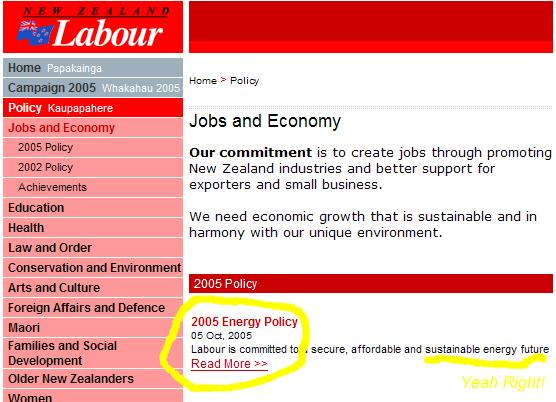
Carbon tax - Labour's broken promise

In September this year Labour went into the election campaign with a Carbon tax as a central part of its Energy policy.

Increase support for renewable fuel and electricity, and by encourage electricity generators to pursue environmentally sustainable electricity generation in preference to environmentally harmful generation (for example through the carbon tax).
...
Increase support for renewable fuel and electricity, and by encourage electricity generators to pursue environmentally sustainable electricity generation in preference to environmentally harmful generation (for example through the carbon tax).


Today the Government announced it is scrapping its own policy to introduce a carbon tax in 2007 in favour of some vague commitments to look at other ways to meet New Zealand's obligations under the Kyoto protocol. By denying that parliamentary numbers were a factor in the u-turn, new Energy Minister David Parker is saying Labour have changed their mind in the three months since the last election - thereby making it a simple broken promise.

No Right Turn already has some excellent analysis of why the carbon tax is needed, and explains why the lack of a carbon tax could actually end up costing New Zealand more money as we will have to buy more carbon credits to cover the 13 million tonnes of carbon reductions the tax was expected to save.

So for now I will concentrate on a few political aspects of this decision I find alarming.

The timing of this announcement is very interesting. It is also extremely cynical.

It will be no accident Labour chose today to also announce the welcome but underweight increase in the minimum wage. No doubt it hopes the attention of Labour supporters will be on the minimum wage increase in tomorrows papers, and not the broken electoral promise to introduce the carbon tax (especially those who voted Labour who might have voted Green).

On the other hand, Labour will hope business groups will welcome Labour adopting another right wing policy and will not get too snarky about having to pay their lowest paid employees a little more to feed their families (business groups are still complaining, only proving the spirit of Ebenezer Scrooge is alive and well this Christmas). Christmas week is also a handy sideshow for Labour.

David Parker says the decision to axe the tax was made independently of coalition partners NZ First and United Future. Given the short time frame since the election, this claim appears to be of questionable credibility. Under Labour's unusual support arrangements cabinet collective responsibility is only meant to apply to their cabinet portfolios. Do you think Peter Dunne as Minister of Revenue (as aspects of the carbon tax would clearly fall within his portfolio) would have been happy defending the Government's position on the carbon tax? I think not. Was a little quiet deal done at the time of the coalition negotiations? I think likely. It is about time Labour came clean and told the electorate what other policies it has sold out to its new right wing friends.

Interestingly, the Energy policy I quoted from above is dated 5th of October 2005, at least according to Labour's website.

Labels: , , , ,

Tuesday, November 29, 2005

Yay for Child Poverty Action Group Boo Labour

Great to see the Child Poverty Action Group win the right to mount a legal challenge to Labour's policy to exclude beneficiaries from the Working for Families package.

Such an exclusion is designed to widen the gap between beneficiaries and the working poor - the very same principle, among others, guided Ruth Richardson's infamous 'Mother of all Budgets' in 1991. It makes the Child Tax Credit (CTC) and the In Work Payment (IWP) nothing more than an indirect subsidy for employers, and lets them off the hook for consistently failing to pay their employees family friendly wages. The benefit cuts of 1991 are still with us, as benefit levels have never been increased in order to restore a similar comparative level with wages that existed prior to 1991.

To make matters worse, 'beneficiaries' is defined to include those receiving a student allowance, NZ superannuation or those on ACC for more than 3 months. So a single mum attending university will not benefit from the CTC or the IWP, and neither will grandparents acting as caregivers after the death of a parent.

Sue Bradford is calling on the Government not to appeal the Human Rights Review Tribunal decision. Sadly this is not an unreasonable fear given the petty litigious attitude of the Government on similar issues in the past (such as on defining a relationship like marriage).

If Working for Families was meant to be about reducing child poverty, it really needs to be asked why children of beneficiaries ought to be worse off, purely based on the source of their caregivers income. Its not something the kids can control after all.

The case is the first under 2001 amendments to the Human Rights Act that allowed Government policies to be challenged in the Human Rights Review Tribunal. It also sets another important precedent by establishing the right of non-governmental organisations (NGOs) to challenge discrimination in public policy, regardless of whether they themselves are directly affected. As an example, this decision could be of great assistance to NGOs working in mental health advocacy, as many people with past psychiatric/psychological issues regularly face systematic and unwarranted discrimination.

Labels: , , ,

Monday, October 31, 2005

Why should public sector CEOs get 15% pay increases, when their staff struggle to keep up with inflation?

In a report released this week, State Services Commissioner Mark Prebble complains that state sector chief executives continue to be underpaid. Despite recently gaining significant percentage increases, those poor public sector CEOs are lucky to take home a $400,000 salary. Does that mean foodbanks now catering for those in a tailored suit and tie?

It is sad that Prebble does not appear to have sympathy for the public sector workers below the level of CEOs, some of whom went on strike last week, in the hope of obtaining far less extravagant pay claims from their public service bosses.

Kevin List of Scoop takes up this issue in the latest 'A Week of It'. I was pleased to see Kevin pick up on a National Union of Public Employees press release from Wednesday last week, featuring a friend of mine, Lynda Boyd. She was commenting in support of Child Youth and Family workers, forced to go on strike after receiving an abysmal wage offer that did not even allow clerical and administrative staff the chance to keep up with inflation.

"At a time when the State Services Commission is talking about pay hikes for public service Chief Executives it is ironic that workers dealing with some of the most vulnerable and challenging people in our society have to take strike action to try and get a decent pay rise. ItÂ’s wrong when frontline workers earning between $10.60 and $12.60 are being offered rises of 3% at a time when public sector CEOs are getting salary increases of 15%,"” said Lynda Boyd of the National Union of Public Employees.


Well said Lynda :)

Labels: , , ,

Wednesday, June 08, 2005

Hail to the bus driver

Really pleased to read in the Press yesterday that Environment Canterbury and the bus companies have renegotiated bus service contracts so they can provide staff with pay rises of about $2 an hour. The deal is very welcome and makes a stark contrast with the ideologically driven deregulation of the Christchurch Transport Board in the early 1990s.

ECan is 'co-funding'” the cost of the deal with Land Transport New Zealand. In Auckland bus drivers are set to get a fair pay increase too - but they had to go on strike twice to get it.

The Christchurch deal is in response to a chronic shortage of bus drivers, currently forcing bus companies to cancel between four and forty trips per day. This demonstrates the destructive and counterproductive effects of both low wages and deregulation. Red Bus pays $13.14 to fully qualified collective agreement staff, while Leopard pays $13.13. Every few years, drivers must update their licences at their own expense (Press 16/4/05).

Red Bus driver "Lucy" says drivers have to work 70 hours a week over six days to make a decent living from driving. "We quickly become exhausted, we rarely see or have time with our families and finally have no choice but to leave the industry completely shattered," she told the Press (16/4/05). Bus companies ban their drivers from taking to the media, so even when they are welcoming the latest deal as "excellent news", they need to use fake names.

Why has there been so little attention given to the reasons why this situation came about? To my mind, the dismal pay levels of Christchurch and Auckland bus drivers is a logical consequence of a narrow minded policy of contracting out bus services to the lowest bidder.

As Amalgamated Workers' Union secretary Calvin Fisher says - the competitive tender process has backfired on the public (Press, 16/4/05). "The position is that ever since public transport has been given to regional councils, all that's happened is that (the services) are contracted out on a tender basis, and that's driven down wages," he says. In 1992, following deregulation, patronage figures sank to an all time low of 6.8 million for the year and the bus system of Christchurch was dangerously close to collapsing altogether.

Christchurch Buses - 'A Cautionary Fable'
In 1990, the citizens of the Peoples Republic of Christchurch were very happy. The Christchurch Transport Board, publicly owned by the people, had just replaced its aging fleet of buses with brand new MAN buses. The citizens cheered. But in 1991 an evil scurge of 'deregulation' came from the north, led by city councillor Pansy Wong (now a National MP) and a National Government. The bus company was expected to be privatised, and each of the routes contracted out to whoever could give the council the cheapest price. It was written that the council must be cheapskates, and consider nothing else, said the new right black magic spellbook. While the council buses remained in public ownership, the CTB was turned into a 'Council Controlled Trading Organisation' (similar to an SOE).

Following the scurge of deregulation, new bus companies came to town, in the oldest, cheapest noisiest buses they could find. Even the schoolkiddies (like me), used to riding in old buses, were appalled at the old bangers now on Christchurch streets.

One day citizens were travelling to work in a nice new comfortable MAN bus, and now they were riding in the buses Auckland had just got rid of, buses that were well over 15 years old (and to make matters worse for Cantabs they were still in Auck'’er yellow). Where have our new buses gone cried the Cantabrians? The market is at work was the reply. The citizens were not happy.

Labels: , , , , ,