Joe Hendren

[ Home ] [ Articles ] [ Blog Home ] [ Travel ] [ Links] [About Me]

Tuesday, October 06, 2009

40 years of Monty Python and an anacdote from Idle

It was forty years ago today, a parrot sat on a perch to play...dead that is.

Oh alright, it was technically yesterday, but Britain will always be hours behind New Zealand.

On October 5 1969, one of my most favorite comedy series ever, Monty Python, first aired on TV. I wasn't even alive, but I don't know whether this means I had the same existential status as the parrot.

To celebrate their 40th anniversary, the surviving Pythons, John Cleese, Terry Gilliam, Eric Idle, Terry Jones and Michael Palin have put together a documentary covering the history of Monty Python and the Python team. A not surviving Python, Graham Chapman, died in 1989.

Monty Python: Almost the Truth (the Lawyers Cut) screened in a UK cinema for one night on the 29th of September. Hopefully it will make its way here - having it on TV over Christmas would be good.

While this is being touted as the first time in 20 years the surviving Pythons have come together on a project, the team did a few sketches in an interview show hosted by Robert Klein in 1998. The Pythons apparently bought Graham Chapman along in an urn of ashes, which Gilliam 'accidentally' spilled on stage and attempted to clean the remains of Graeme with a Dustbuster. Cleese dipped his fingers in to taste it. Wonderfully tasteless!

Almost the Truth may be similar to the book, "Autobiography by the Pythons". While of course this was an very amusing read, I was interested in the mock military training young Eric Idle was forced to endure at boarding school in Wolverhampton in the early 1960s. The indoctrination started from the age of 11.

"Since I was head boy (by default) the school insisted I must be head of the CCF (Combined Cadet Force), which I didn't want to be. At the end of military training they made the mistake of sending us off on a Civil Defence Course which showed just exactly what happened when a nuclear bomb went off, and as a result I had become violently pacifist. During the Easter hols (1962) I went on the Aldermaston March, the annual Campaign for Nuclear Disarmament rally. We marched from Aldermaston in Hampshire to Hyde Park behind banners, signing protest songs, a distance of 54 miles."

"When I got back to school, the padre called me in and said, 'You're a hypocrite, Idle, you're the head of the CCF and went on the Aldermaston March'. I said 'Well I resign', and he said 'You're not allowed to resign'" (p. 40)


In response young Eric adopted an entirely reasonable attitude to enforced militarism and the insistence of its patently pathological underlying values.

"I refused to go to Military Camp at the end of term. It was just a sort of 'fuck you' to the school because they couldn't throw me out. I'd been accepted to Cambridge, I was on the Aldermaston March, I didn't take any of their fucking CCF seriously. I just went off in my own world and that was reassuring, that was really good for me because I could finally say 'Screw you'"

Labels: , , , ,

Saturday, March 11, 2006

More evidence the UK helped Israel get the bomb

The BBC's Newsnight programme has revealed yet more damming evidence demonstrating how the British Government helped Israel develop nuclear weapons during the 1960s (hat tip NRT). Recently released papers show the British supplied to the Israelis many of the chemicals vital to the production of a bomb, including plutonium and uranium. To make matters worse, it appears relevant ministers, including technology Minister Tony Benn, were misled by public servants and were unaware of some of the transactions.

In 1966 Britain supplied Israel with 10mg of plutonium, despite strong warnings from the Ministry of Defence and the foreign Office that even such a small amount could be of significant military value, as it could be used as the basis for experiments to fast track the development of a bomb. There is also evidence that Michael Michaels, the public servant who pushed strongly for the sale, knew how useful small amounts of plutonium would be to the Israelis.

In August Newsnight revealed that the UK Government supplied heavy water shipments to Israel from June 1959. At the time officials claimed "It would be somewhat over-zealous for us to insist on safeguards" against military use. See my earlier post here.

It now appears there were hundreds of shipments of nuclear material from Britain to Israel during the 1950s and 60s.

Earlier this year I was debating Israel's nuclear status with GT (over a beer). I argued that putting pressure on Israel to disarm would strengthen the moral force of the diplomatic pressure currently being put on Iran not to develop nuclear weapons, as Iran would be less able to claim it needed nukes for defensive purposes. GT responded that Israel had possessed nuclear weapons for around 40 years and had not used them against anyone. While this is true, I replied that I suspected this probably had just as much to do with luck as intention.

Recalling this conversation as I read the latest New Statesman article - I found it particularly interesting to note the date Israel is thought to have gained a couple of working nukes. In the leadup to the Six Day War.
"They had a secret weapon - two, to be precise. In the weeks before Israel took on the Arab world in June 1967 it put together a pair of crude nuclear bombs, just in case things didn't go as planned."

As Israel's Arab enemies of June 1967 were nowhere near developing their own nuclear bombs, this suggests Israel developed its nuclear arsenal with a nuclear first strike capability in mind.

From a humanitarian perspective it is probably a good thing it was only a Six Day War. But as the world continues to grapple with the consequences of Israel's illegal land grab of 1967, perhaps talking about a "Six Day War" is somewhat of a misnomer.

Labels: , , , ,

Friday, January 20, 2006

Why does Iran want nuclear weapons?

With all the recent talk about Iran resuming its nuclear programme it is a shame the West continues to undermine its own position with selective morality and obvious hypocrisy.

I find it amazing the Press can have so many articles about this issue yet fail to address the obvious question - 'for what reasons could Iran want nuclear weapons?'

As Simon Jenkins points out, the answer is as simple as looking at a map.
"I would sleep happier if there were no Iranian bomb but a swamp of hypocrisy separates me from overly protesting it. Iran is a proud country that sits between nuclear Pakistan and India to its east, a nuclear Russia to its north and a nuclear Israel to its west. Adjacent Afghanistan and Iraq are occupied at will by a nuclear America, which backed Saddam Hussein in his 1980 invasion of Iran. How can we say such a country has "no right" to nuclear defence?"

Saudi Foreign Minister Prince Saud al-Faisal told the BBC that the West is partly to blame for the Iran nuclear crisis for allowing Israel to develop a nuclear arsenal. He said nuclear weapons benefited no-one, and called for a nuclear-free zone in the Gulf. It would be good to see al-Faisal get some strong support for this idea, as a WMD free Middle East ought to be the goal of any sane policy. Better still, no Security Council Resolution would be required to put such a ban in place, as it is already provided for under existing resolutions.

In 2003 George Bush and Tony Blair attempted to use Security Council resolution 687 as a justification for the invasion of Iraq. While 687 provided no such authorisation, it did call for the elimination of Iraqi WMD and delivery systems as a step towards "the goal of establishing in the Middle East a zone free from weapons of mass destruction and all other missiles for their delivery and the objective of a global ban on chemical weapons." (Article 14). So if 687 is really to be upheld, then pressure must be put on Israel to disarm.

A good start would be for the US and the UK to publicly recognise Israel's possession of nuclear weapons (as far as I know they have never officially recognised this) and ask Israel to agree to arms reduction talks. This would have the advantage of greatly increasing the diplomatic pressure on Iran to abandon its nuclear programme, as it would be much more difficult for Tehran to claim they need nukes for defensive purposes. Many Arab states feel threatened by Israel's nuclear status, especially as Israeli nuclear armed submarines have been known to patrol the coasts of Iran and Pakistan.

Iranian President Mahmoud Ahmadinejad claims Iran 'does not need nuclear arms' and that his country is only asserting its right to peaceful nuclear technology, as allowed under the nuclear Non-Proliferation Treaty (NPT). Unfortunately, countries such as Israel made similar denials in the mid-1960s when they were developing nuclear weapons, so any such denials ought to be taken with a grain of salt, unless said country is happy for the IAEA to make unhinded inspection visits.

In Iran's case, Ahmadinejad needs to be asked why it is so essential for Iran to gain nuclear power stations when the country is sitting on one of the most plentiful gas supplies in the world.

If Iran is successful in developing nuclear arms - this will be yet another dismal failure for the foreign policy of George W Bush. North Korea is named in the 'axis of evil' speech, continues its nuclear weapons programme and withdraws from the NPT. Iran is named in the 'axis of evil' speech, and is now 'breaking the seals' on its three nuclear facilities. It worried U.N chief inspector Hans Blix that in invading Iraq, Bush may have sent precisely the wrong message - the US only attacks countries that cannot defend themselves.

And like most policy questions - it all comes down to who we want to help. Simon Jenkins again.
"All the following statements about Iran are true. There are powerful Iranians who want to build a nuclear bomb. There are powerful ones who do not. There are people in Iran who would like Israel to disappear. There are people who would not. There are people who would like Islamist rule. There are people who would not. There are people who long for some idiot western politician to declare war on them. There are people appalled at the prospect. The only question for western strategists is which of these people they want to help."
---
Edit 14/9/09: Despite this post being over three years old it continues to generate quite a few hits. It is pleasing to know so many people are asking the same basic question that motivated my post. I turned this post into a longer article for Peace Researcher, where I also looked at some of the arguments related to nuclear power. This was published in December 2007.

Labels: , , , , , , , ,

Monday, November 14, 2005

Despite the hype, terrorism is in decline

A friend just emailed me a copy of Paul Robinson's article 'The good news about terrorism". While it was published in the Spectator in April, his commentary is still highly relevant and worth a read. Robinson is a Lecturer in Security Studies at the University of Hull in the UK.

"We are facing the gravest threat that this nation has ever faced.’ Elizabeth I, speaking of the Spanish Armada? Winston Churchill, in the aftermath of Dunkirk? No. Home Office minister Baroness Scotland on Newsnight, justifying the new Prevention of Terrorism Act by reference to the threat from al-Qa’eda."

‘Hang on,’ I said to myself on hearing the Baroness, ‘that can’t be right.’ My mum can remember lying in bed hearing bombs drop, and she once saw a V1 go over and heard the engine cut out as she watched.

Robinson argues that vested interests in the defence establishment have pulled off a confidence trick to convince us to live in fear, by in large to justify their own existence. "The collapse of the Warsaw Pact eliminated the need for 90 per cent of our armed forces" and a good deal other military spending to boot....

"Far from being more dangerous, the world is safer now than ever before; and far from being an ever-growing problem, terrorism has been in sharp decline for over a decade. This is not a matter of opinion. It is provable.

The Stockholm International Peace Research Institute (Sipri) and Canada’s Project Ploughshares both annually track the number of armed conflicts taking place worldwide. Sipri counts only those which result in 1,000 deaths or more in a given year, so its figures are slightly lower. Even so, it agrees with Project Ploughshares that the amount of fighting on the planet is declining. According to Sipri, there were only 19 conflicts in 2003, down from 33 in 1991. With its broader definition, Project Ploughshares reports a decline to 36 in 2003 from a peak of 44 in 1995.

More good news follows, I’m afraid. Battle-related deaths rose slightly from 15,000 in 2002 to 20,000 in 2003 because of the Iraq war, but even these figures are substantially down from the annual tolls of 40,000 to 100,000 during the Cold War. Global military expenditure also fell by 11 per cent in real terms between 1992 and 2000, and the Congressional Research Service in Washington notes that international arms sales fell from £22.8 billion in 2000 to £14.3 billion in 2003. In short, there are fewer wars, fewer arms sales and fewer people dying, each year, than at any time since the second world war.

Robinson also denies that global terrorism poses a new and unprecedented threat to our security. He uses figures from the Rand Corporation MIPT (Memorial Institute for the Prevention of Terrorism) database to show there was a big peak in terrorism in the late 1970s and early '80s, followed by a steady decline ever since. "During the 1980s, the number of international terrorist incidents worldwide averaged about 360 a year. By the year 2000, it was down to just 100....Bluntly, terrorism is a declining problem, despite our best efforts to provoke it."
---
It also should be pointed out that conservative Republicians attempted to whip up fears about international terrorism when Reagan took office in 1981. Libya became the official punching bag. Qaddafi may have been a thug, but most importantly he did not have the military capability to effectively fight back against US aggression. Unlike the USSR Qaddafi did not possess nuclear weapons.

Perhaps the worst failure of the current foreign policy of the Bush administration is that it is teaching Iraq, Iran and North Korea that possession of nuclear weapons and other WMDs represent the only defence that will prevent a US invasion. In those countries, fear is rebounding on the US.

Labels: , , , ,

Sunday, August 07, 2005

Hiroshima Day 2005: Oh dear Don what would Daddy say?

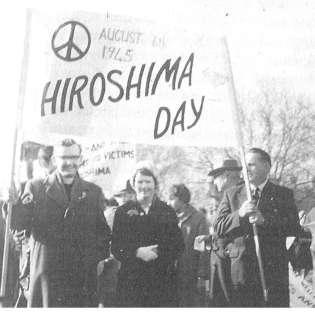
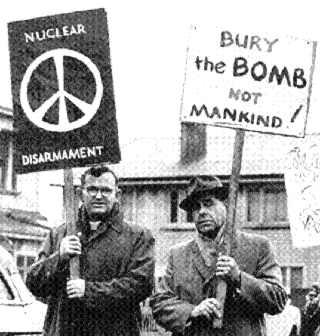
In the early 1960s, The National Committee of the New Zealand Campaign for Nuclear Disarmament (NZ-CND) included none other than a Reverend Alan Brash, father of Don.


On left, Rev. Alan Brash marches in Christchurch on Hiroshima Day 1962.

And what would Brash Senior make of the National party policy "to enhance relationships with our traditional allies" and Don's infamous quip that the ban on nuke ships would be 'gone by lunchtime' if he ever became Prime Minister?

As a leading member of CND in the early sixties, I doubt Mr Brash is all that impressed with Don's mate from school, Lockwood Smith, on hearing that he asked whether it would be "worthwhile for a United States think tank to assist with a public campaign" on the nuclear ships issue. In any case, Mr Brash doesn't think Lockwood sounds like a very honest boy, given that he denied using the words 'think tank' on one radio station, while admitting on another radio station he may have done so (Press, 4/8/05, A4).


On left, Rev. Alan Brash marches in Christchurch on Hiroshima Day 1962, accompanied by leading New Zealand Peace Activist Lincoln Efford. There could not be a better example of how a person can be judged by the company they keep.

Don Brash is now leader of the conservative National party.

Categories: , , , ,

Labels: , ,

Friday, August 05, 2005

Random Historical Interlude #3: UK helped Israel develop nuclear weapons

In September 1958 the UK agreed to supply heavy water without safeguards against military use, enabling Israel to produce nuclear weapons. This revelation follows an investigation by BBC newsnight reporters of documents in the British National Archives. Other files on the matter remain classified.

The 20 tonnes of heavy water were part of a consignment which Britain bought from Norway in 1956, but the UK later decided this was surplus to requirements. While UK officials attempted to make it look like sale from Norway to Israel, the heavy water was loaded onto Israeli ships docked in a British port, half in June 1959 and half a year later (for some reason 5 tonnes was left outstanding).

These officials also attempted to conceal the deal from the US, according to the files, and may not have consulted their own ministers before approving the sale. It appears civil servants in the Foreign Office and the UK Atomic Energy Authority (UKAEA) approved the sale, without safeguards to prevent the heavy water from being put to military use, with one official scrawling that "It would be somewhat over-zealous for us to insist on safeguards".

The heavy water was a vital ingredient for the production of plutonium at Dimona, a secretly build underground reactor in the Negev desert of southern Israel (near Beersheba), built with French assistance. Frank Barnaby, who worked on the British bomb project in the 1950s says he had "no idea" about the sale, "heavy water was crucial for Israel...Therefore it was a significant part of their nuclear programme".

Like any country with a secret nuclear weapons programme, Israel lied about the true purpose of Dimona, and claimed it was a "manganese plant", yet the security measures employed suggest Dimona was far more important (a Libyan civilian airliner and a Israeli fighter were shot down for getting too close).

The released documents suggest money was the primary motivation for the sale. At the time the consignment of heavy water was worth £1.5m, or £20m in today's money.

In 1960 the UK Daily Express exposed the Israelis' work at Dimona, and highlighted the fact Israel was probably making a bomb. The following March, the UKAEA told the Norwegians they thought it was unlikely Israel could have the outstanding five tons, although the deal was commercially "attractive". This was, wrote Peirson, because of "the political sensitivity of Israel's nuclear activities".

Israel is thought to have exploded its first nuclear devices in the mid-1960s, possessing several dozen deliverable atomic bombs by the time of the 1973 war (when Israel went on full nuclear alert).

While the Guardian reports that the Eisenhower administration was "hostile to proliferation" and President Kennedy and his defence secretary Robert McNamara "strived" to stop Israel acquiring nuclear weapons, John Steinbach says the United States also helped Israel develop the bomb (Chomsky says the same thing).

Although the French and South Africans were primarily responsible for the Israeli nuclear program, the U.S. shares and deserves a large part of the blame. Mark Gaffney wrote (the Israeli nuclear program) "was possible only because of calculated deception on the part of Israel, and willing complicity on the part of the U.S.." From the very beginning, the U.S. was heavily involved in the Israeli nuclear program, providing nuclear related technology such as a small research reactor in 1955 under the "Atoms for Peace Program." Israeli scientists were largely trained at U.S. universities and were generally welcomed at the nuclear weapons labs. In the early 1960s, the controls for the Dimona reactor were obtained clandestinely from a company called Tracer Lab, the main supplier of U.S. military reactor control panels, purchased through a Belgian subsidiary, apparently with the acquiescence of the National Security Agency (NSA) and the CIA. In 1971, the Nixon administration approved the sale of hundreds of krytons(a type of high speed switch necessary to the development of sophisticated nuclear bombs) to Israel.

Israel has over 200 nukes, and people wonder why Iraq, and now Iran want weapons of mass destruction? In 2003 George Bush and Tony Blair attempted to use Security Council resolution 687 as a justification for the invasion of Iraq. While 687 provided no such authorisation, it did call for the elimination of Iraqi WMD and delivery systems as a step towards "the goal of establishing in the Middle East a zone free from weapons of mass destruction and all other missiles for their delivery and the objective of a global ban on chemical weapons." (Article 14). So if 687 is really to be upheld, then pressure must be put on Israel to disarm.

BBC - How Britain helped Israel get the bomb
Guardian - US kept in the dark as secret nuclear deal was struck
Guardian - How the UK gave Israel the bomb

Categories: , , , , ,

Labels: , , , , ,

Monday, February 07, 2005

Iran and nuclear weapons

With a tip of the hat to Empire Notes, I found an interesting article on Middle East Report Online that includes very relevant background to the current ‘Iranian nukes’ debate.

In going to war with Iraq, Joost R. Hiltermann says the Bush administration sought to prove that Clinton’s policy of dual containment – a decade of sanctions, threats, military action, and UN-led disarmament had failed to stop Iraq from developing WMD. But Iraq, it turned out, had no WMD in March 2003, and probably did not have any for most of the preceding decade. Hiltermann points out “Iraq, of course, was not the only target of dual containment. So was neighbouring Iran, which likewise was suspected of having secret programs for building weapons of mass destruction and was seen as a destabilizing force hostile to US interests.” As the Bush Administration failed to find their proof of the failure of dual containment in Iraq, will they force a similar method of ’proof’ onto neighbouring Iran?

According to Hilterman, Iran sued for peace from the Iran/Iraq war at the end of the 1980s because Iraq’s escalating use of chemical weapons made Iranian “human wave” assaults ineffective. Human wave assaults are barbaric, but using chemical weapons against them is one step worse. Following Iraq use of chemical weapons in 1983 Iran asked the international community for assistance.
"Tehran’s repeated remonstrations with the United Nations fell virtually on deaf ears. For six years, Iranian diplomats wrought ever more sophisticated legal arguments to persuade the UN that it should have an institutional interest in upholding the relevant precepts of international humanitarian law. In particular, the 1925 Geneva Protocol, which prohibits “the use in war of asphyxiating, poisonous or other gases, and of all analogous liquids, materials or devices,” was directly on point. The UN’s failure to uphold such precepts, the Iranians said, would undermine its credibility and impartiality, while giving rise to a regional arms race.”
Washington also conducted a disinformation campaign that sought to equally blame Iran and Iraq for the use of chemical weapons, a campaign that helpfully took the pressure off Iraq, then a US ally. Faced with journalists asking questions about Iraq’s use of chemical weapons the US slapped on a ban on the export of chemical precursors to both Iran and Iraq in the spring of 1984, despite internal documents showing US officials had been aware of Iraq’s conduct for at least six months.
“It is generally accepted that toward the end of the war Iran had gained the capability to field its own chemical weapons. Parliamentary speaker (and future president) Ali Akbar Hashemi Rafsanjani declared two months after war’s end that “chemical bombs and biological weapons are poor man’s atomic bombs and can easily be produced. We should at least consider them for our defense…. Although the use of such weapons is inhuman, the war taught us that international laws are only drops of ink on paper.”
Hilterman concludes
“[T]he world’s ability to challenge Iran on any programs it may have today is reduced dramatically by the Iranian perception that it has nothing to protect it from WMD in the hands of a regional power, such as Israel, but its own WMD deterrent. The current standoff over Iran’s alleged nuclear weapons program is a graphic illustration of the problem.”
In any discussion of the proliferation of nuclear weapons in the Middle East, the significance of the country starting ‘I’ should be obvious. As the only country with nuclear weapons in the region, the lack of ‘mutually assured destruction’ (MAD) is just plain dangerous, as it can only encourage a regional arms race, as countries like Iran fear that Israel could use nuclear weapons without the disincentive implicit in MAD. Remove the fear of a nuclear cloud from Iran and any moral rationale (if there is any) to develop its own weapons would disappear. This is likely to be the key reason why Iran refuses to permanently suspend its (low-level) uranium enrichment program, even though such processing is not prohibited under the Nuclear Non-Proliferation Treaty (NPT).

Iran is a signatory to the NPT, making it subject to the International Atomic Energy Agency (IAEA) while Israel remains as a rogue state outside of the NPT. Even if it is shown that Iran is disregarding the crucial tenants of the NPT, this does demonstrate the advantage of potentially nuclear capable countries being inside the NPT tent. Of course, signatories with nuclear weapons disregard crucial tenants of the NPT by making no moves to disarm, but that’s another story.

US attempts to dissuade Iran from developing nuclear weapons would have far more force and credibility if they applied the same standards to Israel. In the case of the Middle East it was ‘I’ who cast the first stone. If calls for Iran to stop developing nuclear weapons were combined with a genuine call for a nuclear free Middle East and an unequivocal call on Israel to disarm, the US message would have far more moral force and credibility. Otherwise, it just looks like more US hypocrisy.

Labels: , , , ,