Joe Hendren

[ Home ] [ Articles ] [ Blog Home ] [ Travel ] [ Links] [About Me]

Tuesday, September 01, 2009

Left party make big gains in German elections

Rather enthused with the success of the Left party in the recent German state elections. Conservative Chancellor Angela Merkel will be feeling less confident about the upcoming federal election in four weeks time, after some significant defeats in two of the three state ballots over the weekend.

The Christian Democratic Union (CDU) has lost its majority (31.2%) in the eastern state of Thrirrua. The Left party received 27.4% of the vote beating the SPD into third place on 18.5%. If the Left and the SPD are able to form a coalition there is a chance the Left's Bodo Ramelow will become the party's first ever Premier of a state.

In the West German state of the Saarland, home to Left party co-leader Oscar Lafontine, the Left got 21.3% of the vote, a big improvement on their 2004 result of 2.4%. With 24.5% for the SPD and 5.9% for the Greens, there is the potential to chuck the CDU out of another state.

The CDU did better in Saxony (40.2%) and will probably govern with the FDP(10%). In this state the Left (20.6%) got nearly twice the vote of the SPD (10.4%).

Germany is currently governed at the federal level by a grand coalition of the largest centre right party, the CDU/CSU and the historically centre-left SPD. In the upcoming federal election Merkel hopes to gain the numbers to spurn the SPD in favor of the free market FDP.

The Left party was formed in 2007 as a coalition between a breakaway group from the SPD, WASG, largely based in Western Germany, and the Party of Democratic Socialism (PDS) from the East. WASG included many trade unionists, and a former leader of the SPD, Oscar Lafontane, who is now co-leader of the Left. Its economic policy is not that much more radical than the policies of New Zealand's first Labour Government when it was elected in 1935. Central to the economic policy of the German Left party is: "a Keynesian use of state intervention to balance market forces. In the current election program, this includes socializing the entire banking system, outlawing non-transparent financial products, hedge funds, and venture capitalism, and restricting currency markets."

In many ways the low vote for the SPD in Sunday's elections is a continuation of the loss of support that occured under SPD Chancellor Gerhard Schröder's administration, where he pushed the SPD towards more neoliberal economic policies and cut back the welfare state. Unfortunately, the current SPD leader Frank-Walter Steinmeir is regarded with suspicion by many on the left, given he was an architect of Schroder's right wing welfare and labour reforms.

The SPD has continued to refuse to form a federal coalition that involves the Left party, on the grounds that the PDS was once the old East German Communist Party. In the last federal election in 2005, a majority of Germans voted for a centre-left government, yet they got a centre-right Government instead because the SPD chose to form a government with the conservatives rather than deal with the left. Now the SPD risks loosing its brand from being in bed with the conservatives.

"On the federal level it's very clear, there will not be cooperation with the Left," said SPD head Franz Muentering after preliminary election results from Sunday announced.

Of course a better explanation for the SPD sniping, is that like other former social democratic parties that have embraced key principles of neo-liberalism, it just hates having competition to its left. The attitute of the German Greens towards the left has also been hostile, despite the Left highlighting the common policies of the two parties.

The SDP may fear the reaction of the CDU to a centre-left-left coalition, as the CDU runs hysterical scare campaigns against the prospect of a so called red-red coalition, highlighting the 'communist past' of the PDS and the Left party. I find it quite bizarre that large sections of the German media have bought into this neo-McCarthist nonsense and refer to the left as 'toxic' and the 'political pariah' of German politics.

It is time that someone called the CDU's bluff - most importantly because the CDU can't claim to have a perfect history either. One of the CDU precursor parties, the German National People's Party formed a coalition with the Nazis in 1931. As part of the short lived Government of National Concentration, the party supported Adolf Hitler as Chancellor and the Enabling Act which was the key step towards establishing Hitler's dictatorship. Another CDU forerunner, the Centre Party, more reluctantly supported the Enabling Act. To cap it all off, in December 1966 the CDU made a former Nazi the Chancellor of Germany. Chancellor Kurt Georg Kiesinger was a former card carrying Nazi and worked in radio propaganda section of the Nazi Foreign Ministry. I don't wish to make strong comparisons here, only to demonstrate that perhaps those in glass houses should not be so ready to throw stones.

There must become a point where all the huffing and puffing attempting to associate the Left with the PDS communist past simply becomes stale and irrelevant. Given the passage of 20 years, it is close to the point where the political generation with that past has passed the torch to new representatives. Even those who were involved with the Socialist Unity Party in East Germany, such as Lothar Binksy, were from the younger generation who supported Mikhail Gorbachev's glasnost and perestroika. Binsky is now part of the moderate social democrat faction of the Left, and a co-leader of the party.

The fact that the SPD and the Left have been in coalition government together in Berlin since 2001 ought to cut the wind from the windbags.

For the record I greatly admire what the SPD managed to achieve in the years after World War I, where they created a welfare state well ahead of its time, despite the crippling economic burdens of the Treaty of Versillies. It also must be said the SPD were intollerant of their left even then. But the SPD can't continue to trade on its history while appeasing the neoliberals in its ranks.

Under a political squeeze from the Greens and the Left, the SPD has adopted some politices that we would be unlikely to see from New Zealand Labour at the moment, such as a small tax rise for high income earners and free tertiary education for a person's first degree. We are talking about continential Europe here - not the wannabe Anglo American wild west.

A coalition with the Left Party may have the effect of revitalising the SPD, in a similar way to the way the involvement of the New Zealand Alliance in the government in 1999-2002 gave the appearance of rehabilitating the Labour party from its rabid neoliberal 1980s. A SPD-Left coalition would also serve to rehabitate the Left from its proported past - perhaps thats just what the SPD are afraid of.

So next month I am hoping that Germany will once again give the combined forces of the The Left, The SPD and the Greens a majority of support. Lets hope the SPD learn the lesson from 2005 and remember whose side they are meant to be on.

It is possible left leaning German voters used these state elections to send a message to the SPD - the question is - are they listening?

Unfortunately the current polls seem to indicate a CDU/FDP government is more likely, with the FDP also doing well in Sunday's state polls. One poll showed the Left party on an all time high of 15%, 5% behind the SPD, with the Greens on 10%. The CDU/CSU/FDP together gained 49% support.

Labels: , , , ,

Tuesday, August 19, 2008

Merkel's mistake promising NATO to Georgia

It is unfortunate that German Chancellor Angela Merkel raised the stakes in the Georgian crisis by reaffirming Georgia's hopes of joining NATO. This can only be regarded as a provocation by Moscow. According to news reports tonight the Russians are beginning to withdraw their forces from undisputed Georgian territory, yet Merkel's words have the potential to slow the pullout and extend the crisis.

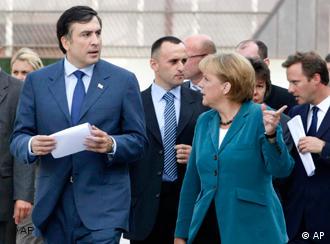
German Chancellor Angela Merkel assured Saakashvili in Tbilisi that NATO remained ready to give membership to the ex-Soviet republic, as promised at a NATO summit in April, despite the conflict with Russia. "Georgia will become a member of NATO if it wants to -- and it does want to," Merkel said on Sunday."

This is an unfortunate chance of stance. Earlier this year Germany led European resistance to plans, pushed by the US to put Georgia on a track to Nato membership.


NATO is nothing more than a relic of the cold war that ought to be disbanded. Its continued existence, particularly as it continues to grow to the East, is a threat to world and European peace. In February 2003 Nato faced a crisis when France and Belgium vetoed the timing of protective measures for Turkey - actions that were seen to assist an invasion of Iraq those Governments did not support. Nato is also involved in American plans to resusitate Reagan's 'Star Wars' plans for a 'missile defence shield' in Europe - moves that threaten the creation of another arms race.

While I have great sympathy for Georgian and South Ossettian civilians caught up in this tank filled powerplay, I have absolutely no sympathy for the Government of Mikheil Saakashvili, who provoked this crisis by invading the disputed South Ossetia region. Making proclamations about territorial integrity and being a UN friendly country have a hollow ring coming from a Government who enthusiastically supported the war in Iraq.

Perhaps Russia could invite Cuba and Venezuela to join the Collective Security Treaty Organisation.

Of course Russia is not blameless over the current crisis. That said, David Hearst makes a very good point when he suggests the response of the West to the Georgian crisis should be mindful of the political forces within Russia the West wishes to encourage. Opposing the extension of NATO is "not appeasement, nor even realpolitik, nor even an abandonment of democratic principles. On the contrary every time events follow the mindset of the hawks in the Kremlin, Russia's dwindling band of democrats gets smaller still and the possibility of regime change in Moscow is set back another generation. The surest way of keeping the hawks in the Kremlin is to keep advancing eastwards. Its a recipe for war, which Europe has no will to fight."

Labels: , , , , ,

Tuesday, October 11, 2005

German grand coalition is formed despite Germans voting for a left wing government

It looks like the new government of Germany will be an "grand" coalition of the SPD and the centre right CDU/CSU parties, led by Angela Merkel as Chancellor.

This is a defeat for the current Chancellor Gerhard Schröder, who pushed to keep his job in the advent of a grand coalition being formed. It now looks likely he will decline a cabinet post in favour of semi-retirement and the chance to spend more time with his daughter.

While cabinet positions are yet to be finalised, it appears the CDU and its Barvarian sister CSU will have eight cabinet posts - Merkel as chancellor, a minister of state at the chancellery, and the economy, interior, defence, agriculture, education and family ministries. The Social Democrats are also expected to have eight ministers in the new government, with the social democrats gaining foreign affairs, finance, justice, labour, health, transport, environment and international development.

The irony is that a majority of Germans actually voted for a centre-left government. A total of 51.1 percent of Germans voted for the three parties to the left of the center, the SPD, the Green party and the newly formed Left Party. Only 43.9 percent voted for the conservatives and the free-market liberal Free Democrats (FDP).

It is a shame the animosity of the SPD and the Greens towards the Left party have denied the German people what they voted for. While it has been widely reported that all three parties rejected any sort of deal, recently many Left party MPs said they would consider supporting a SPD/Green minority government if the SPD would make changes to its neo-liberal agenda. Oskar Lafontaine, the Left Party's designated parliamentary group leader, praised the SPD and Green party agendas and also implied that his party could possibly work with them. Sadly, the SPD and the Greens have only responded with more sniping.

The newly formed Left party, itself a coalition of disenfranchised former SPD members and the PDS (the party that grew out of the communist party) gained 54 seats. With their support the SPD and the Greens could continue to govern with a heathy 40 seat majority in the 614 seat parliament.

Larry Elliott, economics editor of the Guardian, argues the inconclusive vote in Germany is a rejection of the neo-liberal policies pursed by Gerhard Schröder, and would be pursued with even more vigour by Angela Merkel.
"The strong showing by Oskar Lafontaine's Left party is indicative of the deep suspicion German voters have of what to them smacks of a wholesale introduction of the neo-liberal US economic model. Put simply, Germans don't buy the idea - touted by both Mr Schröder and Ms Merkel - that the way to safeguard Germany's post-war social democratic model is to dismantle it."

The mere fact that the SPD would prefer to form a coalition with the conservatives says a lot about the present direction of the SPD. With Merkel as Chancellor the right wing of the SPD will continue with the neo-liberal reforms they wanted to do anyway, and may attempt to blame Merkel for any fallout.

But it is the new Left party that has the most to gain from the CDU-SPD grand coalition. Only a few days ago, the left wing of the SPD were telling Schröder they would never work with Merkel as Chancellor. SPD deputy parliamentary leader Ludwig Stiegler, has refused to vote for Merkel and influential SPD leftwinger Andrea Nahles warned on Thursday against a deal where the SPD traded the chancellery for cabinet posts and policy concessions, which is exactly the kind of deal the SPD have made today.

In order to be Chancellor Merkel still needs to survive a secret ballot of MPs. It is possible a large number of SPD rebels could ignore the whip and vote for Schröder or another SPD candidate. In this situation the Left party could also tactically vote for Schröder, along with the Greens and give Merkel her first taste of defeat.

Nils Diederich, a professor of political science at Berlin's Free University, told the Guardian.
"If the SPD voted for Merkel this would be tantamount to the party shooting itself in the foot. Some 4%-5% of the SPD's core voters would desert it. They would join the Left party instead. It is going to be extremely difficult for the SPD's leadership to sell Mrs Merkel to its own supporters."

With the Greens also set to go into opposition I hope they can mend fences with the Left party. Especially when Oskar Lafontaine claims he could "sign the Green's election manifesto as it is. It's not far from the party that I currently represent". If the Greens and the Left party touted the dream of a coalition without the SPD, this could provide a strong incentive for the SPD to move back in a real Red/Green direction. A lesson for New Zealand perhaps :)

Categories: , , , , , , ,

Labels: , , ,

Wednesday, October 05, 2005

Avoid the sports news for more politics

As a regular viewer of TV3 news I sometimes find myself a little bored when the sports news comes on. I really enjoy the cricket and sometimes the soccer, but I am afraid all the endless analysis of rugby and motor racing and the like bores me.

I find it an irony politicians are often accused of being experts at 'saying nothing', when the All Black coach gets away with saying a lot less, uttering meaningless nonsense such as 'it was a game of two halves' and 'rugby was the winner on the day'.

I don't think its the sports news itself - its the timing. When I am getting my daily fill of televised politics, the sports news sometimes feels like an interruption before the 'real news 'continues on Campbell Live. Noam Chomsky suggests one of the reasons spectator sports are encouraged by the dominant institutions is that it occupies the population, and keeps them from trying to get involved with things that really matter :)

But never fear friends, I found a solution. At 6:30pm on weeknights Southland TV hosts the excellent 'DW-World News'. Its a bit like a German equivalent of BBC World, and yes, it is in English. Lately I have been able to enjoy extended coverage of the German elections and coverage of international news leap years ahead of anything on TV1 or TV3. Each edition includes a special indepth report - allowing much more satisfying coverage of an issue.

Last night Deutsche Welle-TV looked at the two sides of Germany on the 15th anniversary of reunification, following the paths of two industrial towns, one in the west, one in the east. Some Westies complain too much public spending is sent to the east, while a far greater proportion of East Germans are without jobs (18%; double the rate of Western Germany).

This made me wonder two things - do German politicians attempt to use 'the east' as an excuse to cut public spending in the west, and are some of the complaints about high public spending in the east just a veiled form of beneficiary bashing?

DW World News - 6:30 weeknights, Southland TV (Sky Channel 90). Recommended!

Cricket PS: As the sole kiwi representative in the World XI playing Australia tonight, Dan Vettori turned out to be the absolute star with the ball. Vettori took four wickets for 33 runs, including one maiden. Playing in a team alongside Flintoff, Kallis, Akhtar, Muralitharan and Pollock, gaining the standout figures of the innings is no mean feat.
Cricket PS2: Brian Lara just got a duck. Boo! :(

Labels: , ,

Tuesday, June 28, 2005

Movie Review: Downfall

Tonight I went to see Downfall: Hitler and the End of the Third Reich. Mostly set in the narrow passageways of the Berlin underground bunker Hitler and his staff occupied during the final days of the war, the film is loosely based on 'Until the Final Hour', the memoirs of Hitler's young secretary, Traudl Junge.

The film is at one gripping and slow moving, fascinating yet uncomfortable. A word of warning this film does not attempt to santise war for cinematic consumption. A gritty realism allows the film the latitude of a news report (the emergency surgery is especially brutal). The approach works well.

Downfall is a first rate political film at its most personal. The demands of loyalty jarred with reality, and each person in the bunker had to find a way to swim the uncomfortable waves of doubt and emotion. Some kept their faith in the armed forces, and looked like jingoistic fools. Other sycophants agreed with Hitler's every madness, and kept their glib optimism even when the boss had given up. Himmler looked to negotiate peace, driven by his desire to hold on to power, even if this was at Hitler's expense. Dr. Schenck appears as one of the few heroes, as he desperately attempts to save soliders and civilians.

But Hitler made the greatest betrayal of all with his complete lack of concern for the civilians of Berlin, when he lambasted humanity and compassion as a weakness - that the strong ought to crush the weak - schoolboy Nietzsche. Hitler angrily raged that all the best Germans were already dead.

Bruno Ganz gives a gripping and very believable portrayal of Hitler in his final hours. While Ganz is gaining a lot of attention for his amazing performance, I hope this does not overshadow the outstanding standard of the rest of the cast. I really like the way Downfall does not restrict itself to dealing with the cognitive dissonance and emotion of only a few characters - as this gives the film a lot more depth and interest.

If anyone is ever in Berlin I would highly recommend the walking tours. Many of the older buildings still have bullet holes dating from 1945. Hitler's bunker was destroyed in order that it did not become a monument - the surface area is now a carpark of an apartment building.

Labels: , ,

Thursday, January 27, 2005

Remembering Auschwitz


The room of suitcases at Auschwitz

Today marks the 60th anniversary of the liberation of Auschwitz. I often wonder what it would have been like for those very first representatives of the Allies who entered the camp on the 27th of January 1945. I imagine it would have been like an unimaginable nightmare, too unbelievable to be seeing.

I visited the camp in September 2002, and it is an experience I will never forget. As I was going around the camp with the guide I made notes, recording my initial thoughts and reactions. I am so glad I did so, as writing about the experience has helped keep the memories vivid.

Today I added a few photos to my writeup of my visit to Auschwitz. I now have a scanner you see.

If people ever get the chance to visit Auschwitz I would definitely recommend it. While it is an uncomfortable, unsettling, numbing experience I certainly found it worthwhile.

Additionally, the nearby Polish city of Cracow is an absolute gem, as one of the best preserved medieval towns in Europe. At least when I was there, Cracow was not half as touristy as Prague. Cracow remains one of my favorite towns in Europe.

Labels: , , ,

Tuesday, December 28, 2004

Bush Administration: Historical parallels with 1930s Germany

Via About Town, No Right Turn cites a 'great article' by Jim Peron of the Institute for (classical) Liberal Values The Ugly Side of America. Peron is alarmed that his country has been taken over by fundumentalists and divided into competiting extremisms, and sees some historical parallels.
And although I've been proud to be an American for most of my life that pride is shattered. My friends will tell you that I annoyed them by telling them about all the great things about America. I loved the spirit of liberty that made up America and that is embodied in the Constitution. Today I fear that is all dead. It's been pushed aside because of a president who campaigns on fear. He terrorises people into supporting him. If "terrorism" isn't enough he has other bogey men to trot out - hence his campaign against gay people. His whole re-election strategy is built on fear. And when people are afraid - even people who love liberty - they start making excuses for tyranny.

That is what worries me about America. I go back historically to Weimar Germany and see the same type of polarisation and fear. The Weimar Germans were separated into warring camps of extremists. Extreme Left versus the Nationalist Right dominated Weimar politics. People were afraid. Each side feared the other and feared what would happen to their nation if something wasn't done. America is setting itself up for the same "solution" that the Weimar Germans sought.
While I share Jim Peron's concerns over the rise of fundamentalism in US politics and Bush's manipulation of the fear of terror for political ends, his example of Weimar Germany is a poor one.

The polarisation of German politics occurred because the previously prevailing liberal free market economics fundamentally failed. The key economic malaise during the 1920s and 1930s was unemployment and ‘Milton Friedman’ style economics consistently failed to address this problem. The continuation of such policies after the stock market crash simply made things worse. While free market ‘fundamentalists’ may argue this was due to the ideas of Saint Freidman (and the like) not being applied in full, this ignores the key point that during the 1930s economic liberalism was justifiably discredited.

In Germany people were looking for alternatives, and this explains the increase in support for the Nazis and the Communists, who both rejected, to varying degrees, the old liberal economic orthodoxy. In New Zealand the electorate dismissed the policies of the United/Reform government with the election of Labour in 1935. The free market remained in retreat for half a century. It is a sad irony that the ‘free market’ was resurrected as the ‘only alternative’ (sic) to deal with a similar depression during the 1980s and 1990s. The ‘intellectual façade’ of conservatism during the 1980s was a façade indeed – a central claim of the new right of ‘there is no alternative’ was a logical error and its prescriptions had already been demonstrated to be counterproductive during the 1930s depression.

According to the Oxford English Dictionary 'Fundumentalism' means 'the strict maintainence of the ancient or fundumental doctrines of any religion or ideology'. So while Peron is absolutely right to note the rise in religious fundumentalism in the state of America, it also could be said that the Institute for (classical) Liberal Values (ILV) demonstrates an ideological fundumentalism to free markets, in that it appears to believe such artifical creations can do no evil.

ILV, a thinly disgused cheer squad for a faction of the Act party, includes on its board such lumanaries such as Rodney Hide and Lindsey Mitchel. The later promotes himself as a campaigner for the abolution of the Domestic Purposes Benefit, an initiative that came from the development of the welfare state from 1935. So in a sense the ILV and their ideological buddies continue to oppose the policy framework that finally lifted the world from the 1930s depression.

Germany in 1933, after the Nazis gained power, offers a far better comparison with the polarisation and fear engineered by the Bush administration. Following the Reichstag fire, the Nazis claimed they needed new laws to deal to the ‘terrorists’. The Reichstag fire decree has an uncanny resemblance to the Patriot Act. Bush also appears to share the fascist rejection of reason in favour of ‘instinct and will’.

At present I am reading Eric Hobsbawn’s ‘Age of Extremes: The Short Twentieth Century’. In attempting to explain how the capitalism of the US and the communism of the USSR became allies in the fight to defeat fascism, I think Hobsbawn comes up with a very interesting thesis. Both the “liberal democracies” (UK, US, France) and the USSR were founded on the ideals of the enlightenment and the French revolution. Fascism rejected these ideals in favour of an even more traditional order, and thus these ideals formed the basis for the anti-fascist alliance in World War II.

Labels: , , , , , , ,