Joe Hendren

[ Home ] [ Articles ] [ Blog Home ] [ Travel ] [ Links] [About Me]

Thursday, March 26, 2009

Should the Greens weaken their policies to gain greater political support?

Pablo over at KiwiPolitico has an interesting post looking at whether the Greens should consider "a more nuanced and less ideologically rigid, but no less idealist in principle, approach to New Zealand’s foreign affairs". While I do not agree with his general thesis, I believe Pablo has identified some of the tension points that may arise if the Greens ever become part of a Government.

I posted the following as a comment over at Kiwi Politico.

The problem with the idea that the Greens should moderate their politics in order to become more of a mainstream party is that I can’t think of examples where such a strategy has been successful. I also don’t think it takes into account the impact of MMP and the need for parties to maintain a distinct political brand.

Reading your post I could not help but think of the fate of the German Greens, who watered down their foreign policy stance, particularly with Joschka Fischer serving as Foreign Minister. While their 2002 result was slightly higher than 1999, they also lost a lot of their core support. This hardly demonstrates that softening their policy stance will gain the NZ greens significantly greater political support.

A similar story could be told about efforts of Anderton and his cronies to weaken the policies of the Alliance between 1999 and 2002. Their strategy can now be judged, as it describes the policy direction of the Progressives - its ended up with Jim as a single MP.

I also fear you are following the business press when you equate opposition to open economies and current free trade agreements with ‘a generic opposition to trade’. Given the evidence of the many nasties contained in ‘free trade’ agreements, its reasonable to oppose this model while advocating for reform of multilateral institutions and considering trade within a wider economic strategy that considers economic development and the environment. Equating this with opposing trade full stop is a straw man argument aiming to shut down opposition to the free trade agenda. I should clarify that I do not wish to imply you are doing this personally - its more a comment on the free trade proponents who don’t even want to admit there might be negatives to a particular trade deal.

I also agree with what Rich had to say in the comments.

Labels: , , ,

Tuesday, August 19, 2008

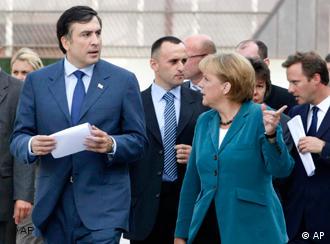
Merkel's mistake promising NATO to Georgia

It is unfortunate that German Chancellor Angela Merkel raised the stakes in the Georgian crisis by reaffirming Georgia's hopes of joining NATO. This can only be regarded as a provocation by Moscow. According to news reports tonight the Russians are beginning to withdraw their forces from undisputed Georgian territory, yet Merkel's words have the potential to slow the pullout and extend the crisis.

German Chancellor Angela Merkel assured Saakashvili in Tbilisi that NATO remained ready to give membership to the ex-Soviet republic, as promised at a NATO summit in April, despite the conflict with Russia. "Georgia will become a member of NATO if it wants to -- and it does want to," Merkel said on Sunday."

This is an unfortunate chance of stance. Earlier this year Germany led European resistance to plans, pushed by the US to put Georgia on a track to Nato membership.


NATO is nothing more than a relic of the cold war that ought to be disbanded. Its continued existence, particularly as it continues to grow to the East, is a threat to world and European peace. In February 2003 Nato faced a crisis when France and Belgium vetoed the timing of protective measures for Turkey - actions that were seen to assist an invasion of Iraq those Governments did not support. Nato is also involved in American plans to resusitate Reagan's 'Star Wars' plans for a 'missile defence shield' in Europe - moves that threaten the creation of another arms race.

While I have great sympathy for Georgian and South Ossettian civilians caught up in this tank filled powerplay, I have absolutely no sympathy for the Government of Mikheil Saakashvili, who provoked this crisis by invading the disputed South Ossetia region. Making proclamations about territorial integrity and being a UN friendly country have a hollow ring coming from a Government who enthusiastically supported the war in Iraq.

Perhaps Russia could invite Cuba and Venezuela to join the Collective Security Treaty Organisation.

Of course Russia is not blameless over the current crisis. That said, David Hearst makes a very good point when he suggests the response of the West to the Georgian crisis should be mindful of the political forces within Russia the West wishes to encourage. Opposing the extension of NATO is "not appeasement, nor even realpolitik, nor even an abandonment of democratic principles. On the contrary every time events follow the mindset of the hawks in the Kremlin, Russia's dwindling band of democrats gets smaller still and the possibility of regime change in Moscow is set back another generation. The surest way of keeping the hawks in the Kremlin is to keep advancing eastwards. Its a recipe for war, which Europe has no will to fight."

Labels: , , , , ,

Wednesday, May 02, 2007

Was World War Two fought for a progressive cause?

Go read Reading the Maps' great post where he argues that Anzac Day actually does a grave disservice to the Anzacs who fought against fascism in World War Two, because it links them to "criminal enterprises" like the Vietnam War.

Maps says WWII is the only conflict New Zealand and Australian troops have been involved in that was fought for a progressive cause - the war against fascism. This is a view I have sympathy for - especially since I read the autobiography of British philosopher Bertrand Russell a few years ago. Russell, a prominent pacifist during the First World War, saw no contradiction in opposing WWI and supporting the war against Hitler.

That said I also think there is a lot in British historian Eric Hobsbawm's characterisation of the entire period 1914-1945 as the "Second Thirty Years War". Hobsbawm likens the mix of major battles and smaller skirmishes throughout the period as being similar to the drawn out war of the 17th century. So, if there had been not been WWI and Versailles it is unlikely there would have been WWII and Hitler.

NZ can be proud to be the only country besides the USSR to show their opposition to the threat to democracy posed by fascist Spain, when our so called Allies (mostly under right wing leadership) supported the policy of appeasement, right up to the point Hitler invaded Poland.

Right wingers who support imperialist wars have a habit of screaming 'appeasement' at left wing opposition, rather than confronting the issues at hand. It is an irony that 'appeasement' largely represents baggage for the right. Prior to the start of the war in 1939, support for the policy of appeasement was most widespread among right-wing conservatives.
According to Hobsbawn:
"Many a good conservative felt, especially in Britain, that the best of all solutions would be a German-Soviet war, weakening, perhaps destroying both enemies, and a defeat of Bolshevism by a weakened Germany would be no bad thing"*.
British Intelligence services continued to concentrate on the 'Red menace' to such an extent that they did not abandon it as their main target until the mid 1930s. It would not be the first or the last time right wing foreign policy 'hawks' had their priorities all out of whack.

Labels: , , , , , , ,

Saturday, October 15, 2005

Are National MPs starting to organise against Brash?

There is ongoing speculation "plenty" of National MPs want to reduce the influence of veteran adviser Murray McCully on leader Don Brash. This is reported to include senior figures such as Lockwood Smith and Simon Power.

McCully currently works as a "Parliamentary Assistant' to the leader of the Opposition.

One source said Mr McCully, who is MP for East Coast Bays, had been part of several strategy teams that had presided over election losses. His abilities were overrated and had at times played a role in poor decisions, the source claimed.

"Plenty of us are unhappy with his influence," the source said. "He has a huge influence over Brash and we still can't understand why. If Brash doesn't start to listen to the broader caucus then he won't survive."

Although Brash won a routine caucus reaffirmation of his leadership following the election, not even Brash is sure whether he will lead National into the next campaign. Those with leadership aspirations, together with those with an axe to grind are now jockeying for position in case an alternative leadership candidate emerges.

Some MPs were unhappy with what they saw as McCully's role in the demotion of MP Katherine Rich from the welfare portfolio after she refused to support the more extreme aspects of Brash's beneficiary bashing.

National insider DPF warns this is about the tenth time since the 1993 election he has heard speculation about the imminent demise of Mr McCully (which in itself speaks volumes about the popularity of the man within the party!). But the real issue here is not whether McCully stays or goes - the moves against McCully have more to do with Brash remaining National's leader.

Some MPs are looking to McCully to be the fall guy for the election loss, others see him as being close to Brash and the type of operator who would work out pretty quickly if someone was 'doing the numbers' within the caucus. The first stage of a palace coup is to take out the palace guard.

More significant, however, is Simon Power wish to gain a major portfolio instead of continuing as Whip of the National Caucus. It is a convention of New Zealand parliamentary politics for the Whip to unquestionably follow the will of the leadership, even internally. This suggests a reasonable explanation for the reason Power does not want to remain as Whip - he wants a free hand to faction against Brash.

Power once held the undemanding portfolio of Defence, only to be fired by Brash for making a hash of it by saying National's foreign policy would be to support our close allies, Australia, the United States and Britain, without reservation, "when and wheresoever our commitment is called upon" (fired for telling the truth perhaps?).

In the Press today Brash makes the position of McCully a confidence issue, warning that those critical of McCully may not get the job they wanted as a result. This barb is clearly aimed at Power.

The latest TransTasman newsletter says McCully attempted to brush off the criticism of his influence over Brash but "has revealed he believes the matter is being pushed by former party golden boy Simon Power". Rakaia MP Brian Connell, better known for his wish to throw cats into fireplaces, is also named as an MP keen to reduce the influence of McCully.

In the event Brash is removed from the leadership (or more likely, Brash is 'convinced' to step down), it is possible the moves against McCully and the change of Whip will be seen as the first steps in the political death of the Don.

Categories: , , , , ,

Labels: , , ,

Tuesday, January 11, 2005

Tsunami aid cricket match and India Pakistan relations

Just finished watching the Tsunami aid cricket match. The Asian XI and the Rest of the World sides succeeded in raising over 14.5 million Australian dollars, a brilliant effort.

But the cricket match was a success in other ways too. In India and Sri Lanka, cricket is not only the national sport; it is a secular religion. As Brian Lara commented a couple of days ago - the shared love of cricket made this match good for the "psyche" of the people of the flood ravaged regions. I will not be surprised if we see television pictures of people in makeshift accommodation listening to the game on the radio. It will provide hope and make people happy.

The sight of Indian and Pakistani players playing in the same side is a diplomatic breakthrough in itself, as cricketing relations have long been affected by tensions between the two countries over the disputed region of Kashmir. A few short years ago some feared this conflict would escalate into a nuclear exchange.

Pakistan last toured India in 1999 only to have the Indian government place a ban on bilateral series soon after. India made its first full tour of Pakistan in 15 years only last year. So in another bit of great news, the Indian cricket board have announced that Pakistan are to tour India from February 25.

One of my long standing travel ambitions is to go to an international cricket game in India. Supporting a kiwi team over there would be great, but so would seeing a match between India and Pakistan. As well as being a great game between two good sides, it would also be a symbol of peace.

---
The autographed shirts worn by the players are being auctioned on Ebay. The shirts for Australian players are currently going for the most, including an incredible bid of 10 million for a bit of cloth with Shane Warne's sweat on it. At the time of posting Chris Cairns' shirt was fetching $7100, Vettori's $5100, and Fleming's $4100. All money to a good cause.

Span tongue in cheekily criticises the Rest of the World team for making too many runs. I suspect a batting lineup that included Ponting, Lara, Gillchrist and Cairns probably made this inevitable. Its a real shame Sachin Tendulkar could not bat, due to an injury. If Tendulkar had got going he could have given the Rest of the World's 344 a run for its money (unintentional pun - honest!)

Labels: , , ,