Joe Hendren

[ Home ] [ Articles ] [ Blog Home ] [ Travel ] [ Links] [About Me]

Tuesday, January 12, 2010

Conscription already a reality in the US

The American war machine is so desperate for numbers it has resorted to a form of backdoor conscription.

A US solider has been jailed on criminal charges in Georgia for writing and recording a rap song that blasts the army and describes going on a shooting spree. Marc A Hall used music to vent his anger after being told he was not allowed to leave the army after four years this February as he had planned, and he would be forced to remain in the ranks for a year-long tour of Iraq starting in December 2009.

The 'stop-loss' policy is the involuntary extension of a service member's active duty retaining them beyond their initial end of term of service. The policy originally dates from Vietnam, but was also used during the first Gulf War and the so called War on Terror. More than 185,000 U.S. troops have been forced to extend their time in the military since September 11. While there is a clause in recruitment contracts allowing involuntary extension to end of term service dates this clause has been subject to some legal challenge, interestingly on the basis that Congress never formerly declared war in the case of Gulf War II (Iraq). 'Involuntary' means it is a form of conscription in all but name.

One can see how soliders who ask to leave could be treated. "No, we will keep you here for another 12 months under stop-loss - if we can't think of a suitably 'brave' mission, I think the bomb disposal squad requires some more recruits" (read cannon fodder)

In 2007 Secretary of Defence Robert Gates ordered military bosses to minimise their use of mandatory tour extensions, and the military responded by increasing its use of stop-loss by 43%.

The Canadian Press reports:
Hall posted the song, called "Stop Loss," on his Web site. Klimaski said he also played it for many soldiers in his unit, the 2nd Battalion, 7th Infantry Regiment of the 3rd Infantry Division. On the recording, Hall denounces the Army for the policy used to keep thousands of soldiers in the ranks beyond their scheduled dates to leave the military. He also raps about opening fire with his military-issue M-4 rifle.

"I got a (expletive) magazine with 30 rounds, on a three-round burst, ready to fire down," Hall raps on the recording. "Still against the wall, I grab my M-4, spray and watch all the bodies hit the floor. I bet you never stop-loss nobody no more, in your next lifetime of course. No remorse."


"They're saying it's a threat. We're saying it's a fantasy," said Jim Klimaski, a Washington civilian attorney who has talked to Hall about the case. "He's mad, but he's not stupid. He's not violent."

I can't help but recall the episode of Blackadder the Forth, set in the Western Front in 1917, where everyone was preparing to go 'over the top'. Blackadder recalled that the traditional way to get out of the fighting was to pretend to be mad, by putting underpants on your head, sticking two pencils up your nose and saying 'wibble'.

As Blackadder said as his final words "Who would notice a madman around here?". Quite.

Update: You can hear Marc Hall's rap here. Predictably the 'shooting spree' as described by the media is only one or two lines of the song.

Labels: , , ,

Tuesday, August 19, 2008

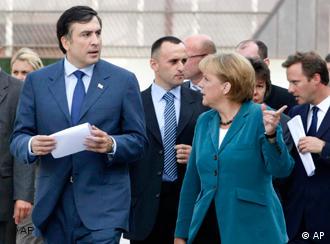
Merkel's mistake promising NATO to Georgia

It is unfortunate that German Chancellor Angela Merkel raised the stakes in the Georgian crisis by reaffirming Georgia's hopes of joining NATO. This can only be regarded as a provocation by Moscow. According to news reports tonight the Russians are beginning to withdraw their forces from undisputed Georgian territory, yet Merkel's words have the potential to slow the pullout and extend the crisis.

German Chancellor Angela Merkel assured Saakashvili in Tbilisi that NATO remained ready to give membership to the ex-Soviet republic, as promised at a NATO summit in April, despite the conflict with Russia. "Georgia will become a member of NATO if it wants to -- and it does want to," Merkel said on Sunday."

This is an unfortunate chance of stance. Earlier this year Germany led European resistance to plans, pushed by the US to put Georgia on a track to Nato membership.


NATO is nothing more than a relic of the cold war that ought to be disbanded. Its continued existence, particularly as it continues to grow to the East, is a threat to world and European peace. In February 2003 Nato faced a crisis when France and Belgium vetoed the timing of protective measures for Turkey - actions that were seen to assist an invasion of Iraq those Governments did not support. Nato is also involved in American plans to resusitate Reagan's 'Star Wars' plans for a 'missile defence shield' in Europe - moves that threaten the creation of another arms race.

While I have great sympathy for Georgian and South Ossettian civilians caught up in this tank filled powerplay, I have absolutely no sympathy for the Government of Mikheil Saakashvili, who provoked this crisis by invading the disputed South Ossetia region. Making proclamations about territorial integrity and being a UN friendly country have a hollow ring coming from a Government who enthusiastically supported the war in Iraq.

Perhaps Russia could invite Cuba and Venezuela to join the Collective Security Treaty Organisation.

Of course Russia is not blameless over the current crisis. That said, David Hearst makes a very good point when he suggests the response of the West to the Georgian crisis should be mindful of the political forces within Russia the West wishes to encourage. Opposing the extension of NATO is "not appeasement, nor even realpolitik, nor even an abandonment of democratic principles. On the contrary every time events follow the mindset of the hawks in the Kremlin, Russia's dwindling band of democrats gets smaller still and the possibility of regime change in Moscow is set back another generation. The surest way of keeping the hawks in the Kremlin is to keep advancing eastwards. Its a recipe for war, which Europe has no will to fight."

Labels: , , , , ,

Sunday, June 24, 2007

The power of Guernica

I have been enjoying Simon Schama's BBC series The Power of Art, which has been screening in New Zealand late on Sunday nights.

Previously the history of art hasn't been a subject that has held my attention for very long, but I really appreciate the way Schama, a historian by trade, places the art in its historical context and explains how each of the works fits into the life of the artist.

Tonight he looked at Pablo Picasso, and the pinnacle of his artistic career, Guernica. This work was the reaction of a politically aware artist to the air bombing of the Basque town of Guenica by German and Italian fascist forces during the Spanish Civil War. The town had no obvious military targets - it was nothing more than an act of state terrorism, dropping bombs on a civilian population.

Picasso created the work to "clearly express my abhorrence of the military caste which has sunk Spain in an ocean of pain and death."

Despite a "polite" response at the time, the painting later came to be seen as a prophecy. Like Winston Churchill, Picasso gained a lot more credit for his stand against fascism after the horrors of World War II.

Schama also shows how Guernica gained an uncanny modern relevance in the lead up to the war in Iraq. Following Colin Powell's presentation to the United Nations where he told a whole lot of lies on behalf of the Bush Administration, Powell and John Negroponte held a press conference where they made the case for war. At the last moment, someone noticed a reproduction of Guernica on the wall, and officials from the Bush Administration demanded the tapestry be covered up in order that it did not upset people. While they did not burn the work, the effect of the large blue curtain was the same.

Now why would the Bush Administration not want their warmongering associated with an image of screaming women and children? Perhaps the image was just little bit too apt, especially for a military caste which has created an ocean of pain and death.

For Schama this episode was a good example of the power of art. The most powerful country in the world cowered in the face of Picasso's masterpiece.

Labels: , , , , , , ,

Tuesday, March 20, 2007

Iraq can be a St Paddy's day issue

On Saturday I joined the anti-war march in Auckland. Scoop has a neat little video with extended coverage of the march here.

There was also the St Patricks Day parade on at the same time, so we had to wait until the paddy costumes had cleared Queen St. As I mulled over the possibility of us cheekly joining in the end of the St Patricks Day parade, even though it was going in the opposite direction, I began to consider the comparisons that can be made between centuries of English imperialism in Ireland and US imperialism in Iraq. The US controlled Green Zone of Baghdad is a modern equivalent of the Pale, the small area around English controlled Dublin in the 14th-15th century. The English phase 'beyond the Pale' has very anti Irish overtones.

The English policy of 'plantation' of Protestant settlers, now has its counterpart in the way the US is lining its multinationals up to take the oil, and the no bid contracts for 'services' in Iraq are nothing but a modern form of Elizabethan patronage. I might add that such practices are now considered corruption.

But then I made the mistake of thinking a St Patrick's Day parade had anything to do with a celebration of Irish Independence. A friend told me they specifically banned any 'political' floats some years ago - meaning the parade was only a 'celebration' of things Irish that have been co-opted by consumerism. So not very Irish at all.

While the Irish eventually got rid of the British in the South, the Americans arrived after World War Two as a brand new bunch of Normans.

The US also currently uses the Irish airport at Shannon to fuel its wars in Afghanistan, Iraq and Terror (wherever country that is). This may endanger Ireland's claim to be a neutral power. In April 2003 the High Court of Ireland ruled that for Ireland to be a Neutral Power under international law, it must prevent "belligerents from making use of neutral territories and neutral resources for their military purposes". Wikipedia also reports:

On 6 December 2005, the BBC programme Newsnight alleged that Shannon was used on at least 33 occasions by United States Central Intelligence Agency flights, thought to be part of a US policy called extraordinary rendition, referring to the non-judicial transfers of prisoners to other jurisdictions, including those where interrogation routinely uses torture. The New York Timesreported the number to be 33, though referring to "Ireland" rather than Shannon, while Amnesty International has alleged the number of flights to be 50, a figure they published in response to Irish Minister for Foreign Affairs Dermot Ahern, who had pledged to investigate rendition if presented with evidence.

Labels: , , , ,

Tuesday, March 13, 2007

Helen's support for Bush's wars

NoRightTurn notes yesterdays announcement by Helen Clark and Phil Goff to "extend" New Zealand's military commitment in Afghanistan. In particular he criticises the decision to continue to operate a New Zealand frigate in the region at the same time US President George Bush is making noises about bombing Iran.

The Government Press Release today says "New Zealand will also again deploy a frigate to join the Maritime Interdiction Operation (MIO) in the Arabian Gulf. The frigate will join the MIO for just over a month in mid 2008 as an extension of a planned deployment to the South/South East Asia region."

There is actually a more fundamental reason why New Zealand should not have a frigate in the Gulf at present. A New Zealand frigate on non-combat duties gives the US and the UK the opportunities to deploy more of their frigates on more active roles, in other words helping to kill the population in Iraq, Afghanistan and (possibly) Iran. So, to the people of the Middle East New Zealand sending a frigate for non-combat duties is as good as dropping the bombs ourselves.

We sent the Te Mana frigate at around the time of the Iraq invasion - perhaps an indication that while NZ publicly opposed the invasion of Iraq, Helen still felt she had to give penance to our so called 'allies' who were bullying all in sundry for "support" for their illegal invasion.

Helen Clark's announcement would not have anything to do with meeting with George Bush next week would it?

PS: Tried to post this last night, but Woosh Internet slowed down to a crawl. Not at all impressed with the speed or reliability of their service, and phone calls to customer service can be left waiting for 30 minutes with no answer. I have no qualms calling from a cellphone!

PPS: The new blogger spellcheck is a big improvement and much easier to use.

Labels: , , , ,

Monday, November 06, 2006

Saddam sentenced to hang

I am disappointed, but not surprised to hear Saddam Hussien has received a death sentence for "crimes against humanity".

Malcolm Smart, Amnesty's director of the Middle East and North Africa, called the trial seriously flawed.

"This trial should have been a major contribution towards establishing justice and the rule of law in Iraq, and in ensuring truth and accountability for the massive human rights violations perpetrated by Saddam Hussein's rule. In practice, it has been a shabby affair, marred by serious flaws that call into question the capacity of the tribunal, as currently established, to administer justice fairly, in conformity with international standards."

It is for these sorts of reasons I wish Saddam had been sent to the International Criminal Court (ICC) instead, along with a few western significant others also to blame for numerous Iraqi deaths. If gassing the Kurds is such a terrible crime (which it is), why not also charge the people who gave Saddam the gas? Unfortunately the citizenship of these alleged criminals would give them refuge in the United States, a country which refuses to recognise the ICC.

It is not that I believe Saddam should not be held to account for human rights violations, but I strongly believe a death sentence in these circumstances will be nothing but counterproductive. Saddam does not deserve to become a matryr - yet he is likely to gain this status when he is gifted a rope.

Saddam could well become a greater challenge to the political stability of Iraq in death than he ever could be in life, especially if the alternative is spending the rest of his life in jail.

Given only the losing side are to be charged for their crimes, this looks very like much like victors justice. In order for a new Government to feel safe, the old leader must die. I am reminded of the decision of the Russian Bolsheviks to shoot the last Czar and his family in July 1918. In giving this order Lenin's administration demonstrated its immediate weakness, not its strength. Perhaps a similar assessment will be made of the scarcely effective Iraqi Government and its support for the death of Saddam. Now the Bolsheviks were able to eventually consolidate their power, but they were in the position of fighting off the invading armies, not depending on said armies for their survival....

Labels: , , ,

Monday, August 01, 2005

The Bush Administration's complete contempt for democracy in Iraq

In the June 27 edition of Focus on Trade, Herbert Docena compiles the complete story on how America have implemented their neo-liberal economic designs on Iraq.

'Shock and Awe Therapy: How the US is attempting to control Iraq's oil and try open its economy" is a very impressive piece of work and while long, is well worth reading. My April 2004 article 'Hijacking of a Nation' covered similar ground - its nice to see someone else reaching similar conclusions, as well as providing some damming quotes and references :)

Even before the invasion Docena quotes documents to show that the US had "sweeping plans to remake Iraq's economy in the US image". During the bombing BP engineers were embedded with the soldiers to locate and secure the oil wells. In May 2003, Defense Secretary Rumsfeld announced the Bush administration would be installing a regime heading by personnel who "favor market systems" and "encourage moves to privatize state-owned enterprises"

The US hand the contract for "transforming" Iraq's economy to US multinational Bearing Point. The contract states "The new government will seek to open up its trade and investment linkages and put in place the institutions promoting democracy, free enterprise and reliance on a market-driven private sector as the engine of economic recovery and growth.". Docena contrasts this 'systematic plan' with the complete lack of any planning for post-war humanitarian, rehabilitation and relief operations.

US Viceroy Paul Bremer illegally changed the "existing laws in force" in Iraq, allowing foreign investors to buy up and take over Iraq's state owned enterprises and repatriate 100% of the profits and other assets at any time (Order 39). As Iam al-Khafaji, who worked with the US in the early states of he occupation but later left, attests, "Many radically new sweeping changes, for example the law on foreign investment, Iraqis were not allowed to review it. They not even given the chance to look at it before it was passed.". Other 'orders' allowed foreign banks into the country and reduced the top tax rate form 40% to a flat rate of 15%, doing away with the principle of progressive taxation.

All of these imposed 'law' changes are clear violations of international law. The Hague Regulations and the Geneva Conventions, which the US has signed up to, outlaw such law changes under occupation. Even though these 'laws' were forced on the Iraqi people before they had a chance to have a say in an election, Bremer also took steps to ensure it would be difficult for an incoming elected government to change the 'Orders' put in place by the Coalition Provisional Authority.

From the earliest days of the occupation, the US searched for Iraqis whose interests converged with that of the US. The US needed Iraqi faces 'out front' to attempt to show they were not colonizers imposing their will on the Iraqi people (yeah right!), and these Iraqis needed the US because lacking constituency and legitimacy, they have no chance of surviving in power without US protection. "What Washington wanted was Iraqis who - while willing to dabble in occasional criticism of the administration - were at the final analysis beholden to it" Middle East Historian Dilip Hiro (Hiro's book on the history of Iraq is well worth reading)

The US also planted hundreds of "advisers" in key ministries and the bureaucracy - including dozens of organisations and agencies who specialise in designing neo-liberal policies. The US also created new commissions and institutions that, according to the Wall Street Journal "effectively take away virtually all the powers once held by several ministries". Paul Bremer appointed the chiefs of the commissions to 5 year terms, which will neatly ensure the US appointees can not be replaced by an elected government.

During the January 2005 elections, the US used its usual "democracy promotion" organs (National Endowment for Democracy, The National Democratic Institute and the International Republican Institute(IRI)) to promote their preferred parties, mostly Allawi's and other parties inside the Iraqi Governing Council, who also dominated the interim government. A IRI survey found 55% of Iraqis did not see the interim government as representing their interests. Bremer and his cronies also made attempts to disallow "rejectionists" such as Moqtada Sadr from being candidates in the elections.

No international monitors were allowed to scrutinize the elections - so there was no way to verify if fraud took place - the world just had to trust the word of the US-installed Iraqi government.

My point at present is not whether Iraq adopts a free market capitalist or a socialised economy. Following the fall of Saddam Hussein, it should be entirely up to the Iraqi people to decide the type of economy they want and the laws that will govern it. Not only are the radical reforms imposed by the CPA in violation of international law, they have been imposed before the Iraqi people have had a chance to have a say in an election. Not only that, but it appears the US have gone to great lengths to ensure any 'elections' are anything but a fair fight.

The actions of the Bush Administration in Iraq demonstrate nothing by complete contempt for democracy.

Categories: , , , , ,

Labels: , , , , , ,

Monday, June 06, 2005

Could Watergate be uncovered today #2 - Palast reaches similar conclusions

Following the revelation that Mark Felt was 'Deep Throat', Bob Woodward now tells his side of the story in a fascinating article 'Deepest Secret' reprinted in this yesterdays Press.

It turns out that Woodward knew Felt a some time before he became a journalist, in a chance meeting in 1970 while Woodward was still a lieutenant in the Navy. One evening he was sent to deliver a package to the lower level of the West Wing of the White House. While in a waiting area near the Situation Room he introduced himself to the man sitting next to him. Mark Felt.

The autobiographical aspects of the article are also interesting. Woodward calls his chance meeting with Felt as a "crucial encounter - one the most important in my life - I see that my patter probably verged on the adolescent. Since he wasn't saying much about himself, I turned it into a career counseling session." Somehow, Woodward succeeded in obtaining Felt's phone number.

The picture Woodward paints of himself as a younger man is not entirely flattering - in a time of his life of "considerable anxiety about his future" he expended "a lot of energy trying to find things or people who were interesting". In other words, he sought people he thought had power, such as the volunteer work he undertook with the office of his local Republican congressman.

In my earlier post, I doubted whether modern commercial newspapers would today dedicate the same level of resources to a story like Watergate, especially if that story happened to threaten the powers that be. In his scoop column, Greg Palast reaches similar conclusions, and goes further. He provides an 'investigative reporter body count' - journalists who have found difficulty in their careers once they had broken a major investigative story.
"There's Bob Parry forced out of the Associated Press for the crime of uncovering Ollie North's arms-for-hostages game. And there's Gary Webb, hounded to suicide for documenting the long-known history of the CIA's love-affair with drug runners. The list goes on. Even the prize-laden Seymour Hersh was, he told me, exiled from the New York Times and now has to write from the refuge of a fashion magazine."


Palast says "access" is now a disease epidemic in US journalism, and not even the Washington Post's Bob Woodward is immune (Woodward is now managing editor).
In return for a supposedly "inside" connection to the powers that be, the journalists in fact become conduits for disinformation sewerage. And woe to any journalist who annoys the politicians and loses "access." Career-wise, they're DOA.
...
After the September 11 attack, when we needed an independent press to keep us from hysteria-driven fascism, Woodward was given "access" to the president, writing Bush at War,a fawning, puke-making fairy tale of a take-charge president brilliantly leading the war against Terror.

The issues with "access" go right to the heart of the highly partisan coverage of the continuing war in Iraq, where news organisations overly rely on so called 'embedded journalists' who accompany US soldiers on their missions. The military gain editorial input, discourage 'unhelpful' stories about civilian casualties and encourage journalists to adopt the dictionary of the occupier, dismissing the Iraqi opposition as terrorists, insurgents or militants, often with a 'helpful' suggestion of a possible connection to Abu Musab al-Zarqawi.

While the Defence Science Board report (Sept 04) contains some valuable analysis of America's relationships with the Muslim world, it says the use of embedded journalists in Iraq has won broad support in government and the media, as it “reduced the potential for Iraqi disinformation (e.g. on civilian casualties) that could have undermined political support in the U.S. and in other countries.‚”. But on the few occasions such journalists did report civilian casualties, their figures are implausibly low, especially when compared to more credible casualty surveys such as the Lancet report.

From a cynical PR perspective (and PR types are notorious for cynicism) it is in the interests of the US to keep things dangerous in Iraq in order to discourage real journalists from discovering what is really going on. It certainly seems to me that news organisations are more dependant on 'embeddeded journalism' now than at the start of the war, especially since the re-invasion of Fallujah.

Labels: , , ,

Tuesday, April 26, 2005

Blair's Attorney General warned war was illegal

Ever since the leadup to the Iraq war in 2003 there have been persistent rumors the UK Attorney General first advised Tony Blair such a war would be illegal under international law. While a 'summary' of AG Lord Goldsmith's legal opinion was made public and appeared to give the war a green light, the Blair government have consistently refused to release the full 13-page document given to Cabinet ministers on the 7th of March. It is now clear why.

According to the Mail on Sunday, Goldsmith's original advice included six grounds in which the proposed war with Iraq could be challenged under international law. These caveats were excised from the summary when it was published 10 days later.
  • In law, there was a strong argument that it was the job of the United Nations - not Mr Blair - to rule whether Iraq had defied the UN's order to disarm;
  • Goldsmith stated UN resolution 1441 ("serious consequences") might not be enough to justify war because it did not include the phrase "all necessary", the UN's usual wording for war;
  • It would be much 'safer' and desirable to go to war armed with a second specific UN resolution.
  • He warned Mr Blair it could be difficult to revive UN Resolution 678 to justify war, as this resolution focused on removing Saddam from Kuwait and did not permit an invasion of Iraq itself.
  • Goldsmith drew attention to the continuing work of UN weapons inspector Hans Blix and his team. On the same day the advice was written Blix said Iraq was being more helpful generally and no weapons of mass destruction had been found.
  • The Attorney General explained that US President George Bush faced fewer legal constraints, as Congress had voted Bush special war-making powers. The US government's opinion on the legality of the war did not apply to Britain.
When Blair claimed that the advice was identical to the 'summary' which declared the war legal it is now clear he was not telling the truth. The AG changed his views, a suggestion given further credence by the uncensored resignation letter of Elizabeth Wilmshurt, who resigned her post as deputy chief legal adviser at the Foreign Office over the Iraq war. US National Security Council legal chief John Bellinger even went as far as to boast "We had a problem with your Attorney General who was telling us it was legally doubtful under international law. We straightened him out."

Demonstrating the folly of attempting to keep such potentially explosive advice under wraps, serving only fuel speculation of its contents, it has now come out a mere 11 days before a general election. Liberal Democrat leader Charles Kennedy is right when he says the issue will "not go away" until Lord Goldsmith's legal advice is published in full. At the very least, this would allow an accurate assessment of Goldsmith's concerns over legality in their proper context of the entire 13-page opinion.

In response, Tony Blair is warning that attempts to "send me a message" at the ballot box may cause Labour to lose marginal constituencies and lead to a Tory Government by the back door. Perhaps Blair should have thought of that before he adopted a Thatcherite economic policy, involved Britain in a war of dubious legality, and then told porkies to cover his tracks. While I regard the Liberal Democrats as a right wing party with some left wing policies (such as on education), their presence in a balance of power type arrangement could be a positive influence on Labour in the next term.

PS: I attempted to post this yesterday, only to have blogger clear the post before I could upload it :(

Labels: , , , , ,

Friday, March 25, 2005

Wilmshurt letter on Iraq war further evidence of increasing politicisation of British civil service

The UK Guardian has obtained the uncensored resignation letter of Elizabeth Wilmshurt, deputy chief legal adviser at the foreign Office until she resigned over the Iraq war. In her resignation letter Wilmshurst dammed the invasion as a "crime of aggression" and "so detrimental to the international order and the rule of law."

When the Blair Government first released the letter under the new Freedom of Information Act, they left out a key passage, a passage suggesting that the attorney general, Lord Goldsmith, believed war against Iraq was illegal - a view he expressed less than two weeks before the Tommies went to Uncle Sam's aid. Wilmshurst says the Foreign Office gave consistent advice that a war would be illegal, before and after UN security council resolution 1441.

She says that was also Lord Goldsmith's view until March 7, when he sent a 13-page written legal opinion to Tony Blair. Ms Wilmshurst does not reveal the content of this advice. However, reports that the attorney warned Mr Blair that British participation in the invasion could be ruled unlawful by an international court have not been denied by the government.

The failure of Blair to obtain a second UN resolution caused both Foreign Secretary Jack Straw and Goldsmith to change their view again. How can legality be so elastic...

In the censored passage of her letter, Ms Wilmshurst points out that the attorney's view changed yet again into a new "official line". That is a reference to a parliamentary answer released by Lord Goldsmith on March 17, the eve of a crucial Commons vote on military action. In this, the attorney said - on the basis of advice from Mr Blair - that it was "plain" Iraq was in breach of its disarmament obligations.

The Freedom of Information Act forced the release of the censored piece of the letter, even though the Foreign Office claimed it was not in the "public interest" - yeah right - on reading the previously deleted passage its pretty clear it is not the interests of the public that are being protected.
My views accord with the advice that has been given consistently in this office before and after the adoption of SCR [UN security council resolution] 1441, and with what the attorney general gave us to understand was his view prior to his letter of 7 March.
Whether or not it could be said that a certain dossier was 'sexed up', the Wilmshurst letter makes it pretty clear heavy political pressure was applied on the public service to provide the conclusions Blair wanted.

It is unfortunate that the debate within the civil service over the Iraq war will encourage greater politicisation of the service. The tradition of British public servants providing 'free and frank' advice is under threat, as is the notion of a professional career service. Such principles have guided the British civil service since the mid 19th century (following the Northcote-Trevelyan reforms), and were the basis for the reform of New Zealand's public service in 1912. The cost of Tony's arrogance over the Iraq war could be a public service littered with cronies (or mini Tonys).

Nevertheless, I should congratulate the UK Labour Government for passing the Freedom of Information Act, even if it was long overdue.

Labels: , , , , ,

Sunday, March 20, 2005

Peace Researcher Article 'The Fog of Iraq' now online

My article 'The Fog of Iraq' from the March 2005 edition of "Peace Researcher" is now online. I examine some of the frank conclusions contained in the November 2004 report of the Defence Science Advisory Board (DSB - Strategic Communication'), a report highly critical of the Bush Administration's efforts in the war on terror and the wars in Iraq and Afghanistan.
“Muslims do not hate our freedom, but rather they hate our policies. The overwhelming majority [of Muslims] voice their objections to what they see as one-sided support in favor of Israel and against Palestinian rights, and the long-standing, even increasing, support for what Muslims collectively see as tyrannies, most notably Egypt, Saudi Arabia, Jordan, Pakistan and the Gulf states. Thus, when American public diplomacy talks about bringing democracy to Islamic societies, this is seen as no more than self-serving hypocrisy."
I also look at the work of Boston Globe journalist, Molly Bingham, who spent months in Iraq researching the makeup of the Iraqi resistance. She concludes:
The composition of the Iraqi resistance is not what the US administration has been calling it, and the more it is oversimplified the harder it is to explain its complexity....My objective is not to romanticize the fighters or their fight, but merely to better understand what our realistic choices are in Iraq and the Middle East.
Read the article

Labels: , , , , , ,

Saturday, March 12, 2005

US locks up kids in Abu Ghraib

Documents obtained by the American Civil Liberties Union reveal the US is locking up children inside Abu Ghraib prison in Iraq. A prison now infamous for the mistreatment and abuse of inmates. (Washington Post / AP article)

Brig. Gen. Janis Karpinski, who was in charge of Abu Ghraib from July to November 2003, said she often visited the prison's youngest inmates. One boy "looked like he was 8-years-old...He told me he was almost 12," Karpinski said. "He told me his brother was there with him, but he really wanted to see his mother, could he please call his mother. He was crying."

In an interview with Maj. Gen. George Fay, Karpinski said the Army began holding women and children in a high-security cellblock at Abu Ghraib in the summer of 2003 because the facility was better than lockups in Baghdad where the youths had been held.

While one desperately hopes no 11 year olds were subjected to the highly degrading abuse, often with sexual themes, inflicted on adult prisoners, the released articles suggest well documented abuse of children did occur. Six witnesses report three interrogators and a civilian interrogator (in various states of drunkenness), forced a 17 year old girl to expose her breasts and kissed her. According to the documents, the perportrators went unpunished. Imagine the outcry if an American girl of a similar age was subject to such harassment?

In another case troops poured cold water and mud over the 17 year old son of an Iraqi General, in an attempt to break the General by letting him watch his son shiver in the cold. If there is some chilling consequentialist reasoning behind involving an inmate's children in an interrogation, it can only give simplistic consequentialism a very bad name.

Links and more background on this are available at Empire Notes

The United Nations and the world community needs to denounce these US crimes, committed by and/or overseeing, by the American military. Imagine the response of the US if any other country was responsible for such abuses? 'A few bad apples', remarkably timely attempts to discredit the UN and claims of 'anti-americanism' should be seen for what they are - the excuses of quislings* who out of conviction believe 'anything goes' in the War on Terror, the phony war that it is.

* 'Quisling' is based on the name of a Norwegian Nazi, and is used to describe the political forces within states attacked by Hitler who chose out of conviction rather than expediency to join their country's enemy.

Labels: , , , ,

Thursday, December 23, 2004

The Fog of Iraq

This morning I watched ‘The Fog of War’, a documentary film comprising of an extended interview with Robert S. McNamara, the secretary of defence under the Kennedy and Johnson administrations.

For me, McNamara’s discussion of the importance of ‘empathising with the enemy’ was the most interesting part of the film, especially as his ‘lesson’ has direct relevance for the US shambles in Iraq.

During the Cuban Missile Crisis John F. Kennedy was lucky enough to have someone at his side that knew the Soviet Premier Khrushchev well, and was able to predict (accurately as it turned out) the kind of compromise that Khrushchev needed in order to defuse the crisis without the need for war. Athough he may not be a household name, Tommy Thompson, the former US ambassador to Moscow may have saved more than a few households.

McNamara: “We must try and put ourselves inside their skin and look at us through their eyes, just to understand the thoughts that lie behind their decisions and their actions.”

Later in the film McNamara makes a very interesting comparison between the outcomes of the Cuban Missile Crisis and the War on Vietnam.
“In the Cuban Missile Crisis, in the end I think we did put ourselves in the skin of the Soviets. In the case of Vietnam, we didn’t know them well enough to empathise. And there was total misunderstanding as a result. They believed we had simply replaced the French as a colonial power and we were seeking to subject South and North Vietnam to our colonial interest, which was absolutely absurd. And we, saw Vietnam as an element of the Cold War. Not what they saw it as, a civil war."
The Bush Administration and the mainstream media have made no effort to empathise with Iraqis, and demonstrate a glaring ignorance of their history. As I have written before the consistent dismissal of the Iraqi opposition as terrorists, insurgents or militants, often with a suggestion of a possible connection to Jordanian extremist Abu Musab al-Zarqawi, actually tells us very little. But the use of empty verbs does make it easier for those supporting the occupation to create the impression that any “violence” (but never US violence) is somehow without reason, or simply an attempt to ‘disrupt elections’.

In the Boston Globe, Molly Bingham writes why elections won't quell Iraq resistance.
The composition of the Iraqi resistance is not what the US administration has been calling it, and the more it is oversimplified the harder it is to explain its complexity....My objective is not to romanticize the fighters or their fight, but merely to better understand what our realistic choices are in Iraq and the Middle East.
Even a cursory glance of Iraq’s twentieth century history reveals a long struggle to gain and retain Iraqi independence, first from the Turks and then from the British. Even on the basis of recent history, it is reasonable for Iraqis to fear that the US will act like another colonial power, as the Americans have set up permanent military bases and have opened Iraq up for unrestricted US investment and repatriation of profits (read plunder). Halliburton now has effective control of the oil, thanks to ‘reconstruction’ contracts, and is very likely to be looking to ensure this control remains permanent.

I think the left has been a little unsure of itself in deciding whether or not to support the Iraqi resistance, largely because many have felt unsure about exactly what they were supporting. But a first step is to give up the erroneous impression, created by the occupiers, that the ‘insurgents’ represent a uniform group with the common goal of hating democracy. Attempting to ignore the resistance is a more common response. More understanding and empathy is required.

Much of the resistance sprung immediately in response to the illegal US invasion. Given the resistance is a nationalist response to the invasion, it seems safe to assume that no elections will be regarded as legimate while Americans remain in control of the political process.

Empathy is something the left usually does well. So lets have more of it.

Labels: , , , , ,

Sunday, November 21, 2004

The Fall Guy of Fallujah

Been thinking more about the case of the US Marine caught on tape shooting an Iraqi solider. Shooting a wounded unarmed solider is a clear breach of the Geneva Conventions. Article 3 holds that "persons taking no active part in the hostilities, including members of armed forces who have laid down their arms and those placed hors de combat (out of combat) by sickness, wounds, detention or any other cause, shall in all circumstances be treated humanely".

There is certainly a case for the Marine to be charged, but why is no one talking about the culpability of his commanders and superiors? According to the press release issued by the US Central Command the purpose of this investigation is to "determine whether the Marine acted in self-defence, violated military law or failed to comply with the Law of Armed Conflict". But there are other obvious questions. Why did senior commanders allow a Marine with facial injuries who had recently seen one of his buddies being killed head straight back into combat?

I can see parallels with the case of Lynley England already. Despite clear indications the abuse of prisoners at Abu Ghraib was sanctioned, even encouraged by those further up the chain of command, so far only low level soldiers have been charged over the scandal. While Lynley England was involved in some appalling and degrading treatment of prisoners it occurs to me that she was also a scapegoat for the appalling actions and decisions of others. Seymour Hersch alleges that Rumsfeld authorized the use of questionable interrogation tactics to facilitate the accumulation of actionable intelligence. For there to be justice all must be held to account.

Is this pattern going to repeat itself in the case of the Marine? Will he become the public face, the fall guy of Fallujah?

When a Pentagon spokesperson, Lt Colonel Barry Venable commented on media coverage of this case in comparison to other alleged homicides involving soldiers of the 1st Cavalry Division, he said "Not to diminish the severity of the incident, but the difference is that there was a camera present for this one." (Press, 18 Nov) So in the case of the Marine and Lynley England, was the camera the crime?

As well as the Geneva Conventions I also had a look at the US Army's own Law of Land Warfare. It states;
501. Responsibility for Acts of Subordinates
In some cases, military commanders may be responsible for war crimes committed by subordinate members of the armed forces, or other persons subject to their control. Thus, for instance, when troops commit massacres and atrocities against the civilian population of occupied territory or against prisoners of war, the responsibility may rest not only with the actual perpetrators but also with the commander. Such a responsibility arises directly when the acts in question have been committed in pursuance of an order of the commander concerned. The commander is also responsible if he has actual knowledge, or should have knowledge, through reports received by him or through other means, that troops or other persons subject to his control are about to commit or have committed a war crime and he fails to take the necessary and reasonable steps to insure compliance with the law of war or to punish violators thereof....
So based on Bush being 'Commander in Chief' there could be a case to put Bush and Rummy on trial for war crimes based on the events of Fallujah and Abu Ghraib.

It is becoming pretty clear that US senior commanders are out of control in Iraq. There have been several other possible violations of the Geneva Conventions during the reinvasion. Since my last post, the International committee of the Red Cross has condemned the "utter contempt for humanity" shown by all sides in the fighting in Iraq. Complying with international humanitarian law was "an obligation, not an option."

Labels: , , , ,

Wednesday, November 17, 2004

Many more war crimes in Fallujah

Over at Empire Notes Rahul Mahjan collects recent reports demonstrating the extent "the Geneva Conventions are out the window" in Fallujah. While the news may concentrate on the war crime of shooting an unarmed injured person this is but one serious breach.
The way the attack on Fallujah has been conducted makes one thing crystal clear: the Geneva Convention has been overtly and specifically abandoned, not just in the treatment of prisoners, but also in the conduct of military assaults.
The US military have defined all men of military age in Fallujah (15-55) to be targets, and claim that preventing all from leaving is the key to the success of the mission. They insist male Iraqis stay in a battlefield area. This is chilling - as it entails the mission can only be successful when the majority of Iraqis in Falluja are dead, whether they are civilians or combatants. Seemingly to increase the effectiveness of the civilian trap, US troops cut roads and bridges leading to the city.

Preventing civilians from leaving a combat zone is a clear war crime. The Geneva Conventions, recognised as the 'laws of war', require military forces to protect civilians as refugees and forbid returning non-combatants into a combat zone. On November 13 AP reported the following in a story called "Four choppers hit as forces spread"
A stream of refugees, about 300 men, women and children, were detained by American soldiers as they left southern Fallujah by car and on foot. The women and children were allowed to proceed. The men were tested for any residues left by the handling of explosives. All tested negative, but they were sent back.
As Empire Notes says, this clearly shows these men were non-combatants.

The refusal of the military to recognise legitimate non-combatants reminds me a great deal of their refusal to recognise those held in Guantanamo Bay as prisoners of war. Just as the have unilaterally redefined 'prisoner of war' not to include 'enemy combatants', they now appear to define a combatant as any Iraqi that happens to be armed with a Y chromosome.

There are further breaches of the Geneva Conventions. The Forth Convention says.
Art 18: Civilian hospitals organized to give care to the wounded and sick, the infirm and maternity cases, may in no circumstances be the object of attack but shall at all times be respected and protected by the Parties to the conflict.

Art. 19. The protection to which civilian hospitals are entitled shall not cease unless they are used to commit, outside their humanitarian duties, acts harmful to the enemy. Protection may, however, cease only after due warning has been given, naming, in all appropriate cases, a reasonable time limit and after such warning has remained unheeded. The fact that sick or wounded members of the armed forces are nursed in these hospitals, or the presence of small arms and ammunition taken from such combatants and not yet been handed to the proper service, shall not be considered to be acts harmful to the enemy.
So making Falluja General Hospital one of the first targets, in a surprise attack, is another likely war crime. The US claims the hospital was a 'centre of propaganda' because of the way it reported civilian casualties, which would be a stretch to be an act 'harmful to the enemy' and far more likely to be regarded by medical staff as a humanitarian duty. Any PR coming from the hospital is far more likely to be pulmonary resuscitations, not press releases. And perhaps even a pinch of reality.

The US is a party to the basic Geneva Conventions, but has not ratified some of the later Protocols - something it has in common with other 'rogue' states. Despite the fact the US has not ratified Protocol I; it is still widely recognised international law. In the light of recent events, it makes interesting reading.
Art. 50. Definition of civilians and civilian population

1. A civilian is any person who does not belong to one of the categories of persons referred to in Article 4 (A) (1), (2), (3) and (6) of the Third Convention and in Article 43 of this Protocol. In case of doubt whether a person is a civilian, that person shall be considered to be a civilian.

2. The civilian population comprises all persons who are civilians.

3. The presence within the civilian population of individuals who do not come within the definition of civilians does not deprive the population of its civilian character.

Labels: , ,

Thursday, October 21, 2004

Distorted media coverage of kidnappings in Iraq will only lead to more deaths.

Many aspects of the media coverage of the latest kidnapping in Iraq trouble me. I believe the case of Margaret Hassan especially highlights the biases of western media, not to mention the self-interested reactions of western politicians.

As news of the kidnapping broke, reactions in the media were full of surprise and dismay that a British person who has lived in Iraq for 30 years, is married to an Iraqi and considers herself to be an Iraqi could be the victim of the kidnap gangs. This is only a surprise if one assumes it is unusual for an Iraqi to be kidnapped. In fact, many more Iraqis than westerners have lost family members to the kidnap gangs, money often being the primary motive, as ransoms become a barbarous form of 'gangster capitalism'. Consider the following from a "girl blog from Iraq" Baghdad Burning, posted on the 3rd of October.
I'm very relieved the Italian hostages have been set free... and I hope the other innocent people are also freed. Thousands of Iraqis are being abducted and some are killed, while others are returned... but it is distressing to see so many foreigners being abducted. It's like having a guest attacked in your own home by the neighbor's pit bull- you feel a sense of responsibility even though you know there was no way you could have prevented it.

I wasn't very sympathetic though, when that Islamic group came down from London to negotiate releasing Kenneth Bigley. I do hope he is returned alive, but where are all these Islamic groups while Falluja, Samarra, Sadir City and other places are being bombed? Why are they so concerned with a single British citizen when hundreds of Iraqis are dying by the month? Why is it 'terrorism' when foreigners set off bombs in London or Washington or New York and it's a 'liberation' or 'operation' when foreigners bomb whole cities in Iraq? Are we that much less important?
Tony Blair said his government would do everything it could to secure Ms Hassan's release. "This is someone who has lived in Iraq for 30 years, someone who is immensely respected, someone who is doing her level best to help the country," he said. "It shows you the type of people we are up against, that they are prepared to kidnap somebody like this.". This is all he said on the issue, see Downing Street statement. By turning the issue into a simple US vs THEM dichotomy, Mr Blair does little to explain the possible reasons behind the kidnapping, and thus does not appear to be engaging in the key task of assisting Ms Hassan's release. To some, his comments could appear to be a politically motivated attempt to remind the anti-war faction of his party that they are 'terrorist' targets too.

Felicity Arbuthnot, an Irish freelance journalist and long-time friend of Ms Hassan appears to have given Blair a clear rebuke when she said she hoped that Blair would step back and allow the Irish government to lead efforts to secure her release. In contrast to Blair, Irish Foreign Minister Dermot Ahern, said his thoughts were with the Hassans: "I stand ready to contribute in any way we can to help secure her release." (Guardian)

Blair's US vs THEM language go right to the heart of my second key concern regarding the media coverage, in which the kidnappers are described as terrorists, insurgents, or militants, often with a suggestion of a possible connection to Jordanian extremist Abu Musab al-Zarqawi. In fact, such descriptions tell us very little. They also give the erroneous impression that the 'kidnap gangs' are a uniform group with a common goal. Consider the kidnapping of John Martinkus, as reported by his journalist friend Christopher Allbritton on the 18th October (click this link - its an amazing story).
We're not sure what all happened during [John's] captivity, but he was able to persuade his captors that he was an Australian and a friend to the resistance and not to the Americans. It appears, by the kidnappers' statements and questions, that they were nationalists and not jihadis, lucky for John. Also, he was lucky for not being American, because the kidnappers said if he had been, they'd have killed him quickly....

At one point, one man disappeared, saying he would check out John's story. He came back after about 15 minutes, John said, convinced John was who he said he was. We suspect they Googled John, because they referenced previous stories he had covered.
....
John was lucky -- very lucky. He was picked up by nationalists who, we hear, are getting out of the kidnapping and beheading business. He wasn't an American. He had a pedigree of lefty, anti-war reporter. And he fell in with a (more or less) kind-hearted bunch who were just doing their job as national resistance fighters. (He said they expressed concern that he wasn't married and that his living arrangements in the Hamra weren't safe. Bizarrely, they offered to let him stay with them the next time he came to Iraq -- I'm sure.)

Not sure I would go as far as to call them a "kind hearted bunch", but it does give some hope the violence will diminish when Iraqis are given back their country free of foreign armies. It might be unlikely that the group holding Ms Hassan are such a "kind hearted bunch", one can only hold on to the slim hope her captors also know how to google. Margaret Hassan strongly campaigned against the cruel sanctions regime, enforced by the US following the Gulf War of 1991. "In the build-up to the war last year, she warned MPs of the humanitarian catastrophe another conflict would bring. In January 2003, she travelled to New York and spent a week briefing the members of the UN security council and UN agencies on the dire consequences of military action" (Guardian, ibid).

If we are unable or unwilling to accurately ascertain the identity, motives and demands of those doing the kidnapping, more lives will be lost.

Labels: , , ,

Sunday, October 17, 2004

Iraq opens oil reserves to Western companies

Just read a report on the NZ Herald Online 'Iraq opens oil reserves to Western companies'.

Opening up Iraq's natural resources to widespread foreign investment completes the neo-liberal agenda of the US and its former viceroy Paul Bremer. In September 2003 Bremer imposed Order 39, a 'law' that rescinded nearly all of Iraq's legal and constitutional restrictions on foreign investment and banking. This law allowed 100% foreign investment in Iraqi companies (and state assets) and 100% repatriation of profits to their offshore owners. The only sector to be excluded from this carte blanche neo-liberalism was 'natural resources' (i.e. oil). This law is clearly illegal under the Geneva and Hague conventions, as Iraq was under under military occupation when Bremer imposed the changes, and the provisions of Order 39 clearly breached Iraq's constitution of 1970, a constitution that is still valid under international law.

Oil was exempted from Order 39 because it was thought that domestic political opinion would not stand for it. That’s not to say these changes were in any way democratic, as Order 39 was imposed before elections. The US clearly thinks that Iraqis will be happier with US part ownership of oil infrastructure, if the policy is advocated by an Iraqi face. This is where the (unelected) interim government comes in.
In an interview in a Shell newsletter that is distributed to its Middle Eastern clients, [Oil Minister] Mr Ghadban added that Iraq would open its doors to the oil giants early next year.

"We would like to open a dialogue with international oil companies [IOCs]. We are now formulating our policies ... and we think there is room for IOCs in Iraq - in particular in the upstream because we need new investment."

"We believe that there is at least 2.5 to 3 million barrels per day of new oil production capacity that could, in the long term, be added to our production levels."


The 'problem' for such 'investment' is the 1970 constitution that provides that "natural resources" and the "basic means of production" are owned by "the People". Not even Bremer attempted to override the clear constitutional prohibition to foreign ownership of the oil. It would not surprise me if the latest comments by the 'Iraqi' Oil minister are part of a strategy to move public opinion in favour of privatisation. Expect the interim unelected 'government' to stitch up a deal with BP or Shell and then claim 'there is no alternative' to Iraqis accepting full or part US/UK profiteering from the oil. Then expect such clauses to be missing when a replacement constitution for Iraq is drawn up next year.

Luckily, global justice activists have time to fight this issue, as the western oil companies are hesitant about investing in Iraq while the violence continues.

The Iraqi Oil Ministry was forced to cancel a conference in April when most companies pulled out after a surge in violence in the country.
...
Today, neither BP nor Shell has any staff working there. Shell has one consultant in Iraq and it is monitoring developments from its Dubai office. A spokeswoman refused to say if it was planning to send employees to the country. But she added: "Iraq does offer opportunities. We are following developments and working with the Iraqi Minister of Oil.". A BP spokesman said that the company would only consider opportunities in Iraq when "there is a proper regime" in the country.

While it would be nice to think that BP regards the current Iraqi administration as illegitimate, it is more likely they are worried about the prospect of their 'investments' being renationalised by a future representative Iraqi government, on the grounds that privatisation under effective occupation is illegal (and they would be right!)

Also expect US relations with Saudi Arabia to cool further as more barrels of oil roll out of Iraq. Saudi Arabia was one of the most significant beneficiaries of the 1991 Gulf War, as it was able to increase its production as Iraq's oil infrastructure was bombed. Saudi Arabia picked up the slack, and Iraq will soon want and be able to take the 'slack' back.

Labels: , , , , , ,

Thursday, September 30, 2004

Ironic twist to Blair 'victory' at UK Labour conference

This afternoon the UK Labour conference voted down a motion calling for an early withdrawal of British troops from Iraq. Many are calling it a lucky escape for Tony Blair. (Guardian report)

While at first glance the result looks like a sound victory for Blair, with 86% of the conference voting against the 'rebel' amendment (14% for), Blair only avoided defeat by gaining the support of the 'big four' unions at the eleventh hour, after days of tense negotiations.

The 'rebel amendment' was a moderate one, calling for Blair to set a date for the early withdrawal of British troops. Given that it is at last becoming widely recognised that a key driver of the insurgency is the presence of the foreign troops, sending a clear signal that Britain does not intend to have a permanent military presence in Iraq may help to calm the situation. A date would have been a clear signal, even if events transpired whereby the forces were there for a short time after the designated date.

Jack Straw attempted to claim that the US, UK troops in Iraq were not an army of occupation, but were there at the request of the interim government and with the support of the United Nations Security Council. But the credibility of Jack's justification is seriously strained by actions of its 'coalition partner', especially as the US appointed the government that made the 'request' and the clear US plans to have a network of permanent military bases in Iraq long after an elected government takes power. The military occupation of Iraq will last decades, not months or years.

When it is taken into account that the 'big four' control 40% of the Labour party conference votes it can easily be seen that the vote was far closer than it first appears - had the unions voted in consistency with their previous clear anti-war views - Blair would have lost (14% supported the motion today and 14% plus 40% is 54%).

There is a deep irony when today's vote is compared to the debate over rail renationalisation at the same conference a few short days ago (Guardian).

On Tuesday the conference overwhelming voted in support of renationalising the railways, despite the protests of the Labour leadership, including Chancellor Gordon Brown and Transport Secretary Alistar Darling. 64% of the conference voted to bring the private rail operating companies back into public ownership, with 36% voting against. Gordon Brown attempted to scaremonger, claiming that renationalising rail would cost £22 billion, seemingly ignoring the obvious option of buying up the long term contracts and phasing out the rest as they come up for renewal. Although the conference motion is meant to be binding, the leadership has already dismissed the possibility of rail renationalisation being included in the Labour manifesto.

BBC news reported that Labour's high command blamed the block voting of the 'big four' unions for the loss, with the Blairites rather pitifully claiming a 'moral victory' because a majority of electorate committees failed to support the renationalisation motion. While a majority of electorate committees voted against the withdrawal amendment today (70%*), Blair got 80% of the union votes - in the twisted Blairite logic does this make it a 'moral defeat'??

Today the British Labour party had a chance to save itself from the poor judgement of its leadership, under the glare of generous television coverage. Ultimately by defeating a moderate motion that called on Blair to set a date for the withdrawal of British troops, it may not escape being branded with Blair's mistake. With this is mind, the left may be best to organise elsewhere.

* these figures flashed up briefly on the BBC

Labels: , , , ,

Sunday, July 18, 2004

'Are we seeing a popular revolution in Iraq' now online

I have added my article from the June issue of Peace Researcher, 'Are We Seeing a Popular Revolution in Iraq' to the articles section of the site.

At the time I wrote the article it was a given 'truth' in the general media that the insurgents active in Iraq were not Iraqis fighting for the liberation of their country, but foreign terrorists and former Baath party supporters. Most of the media still seems to swallow this line without critique or comment.

Since I wrote the article I have discoverd some very interesting figures courtesy of Empire Notes. On July 7 USA Today reported that:
"Suspected foreign fighters account for less than 2% of the 5,700 captives being held as security threats in Iraq, a strong indication that Iraqis are largely responsible for the stubborn insurgency.

Since last August, coalition forces have detained 17,700 people in Iraq who were considered to be enemy fighters or security risks, and about 400 were foreign nationals, according to figures supplied last week by the U.S. military command handling detention operations in Iraq. Most of those detainees were freed after a review board found they didn't pose significant threats. About 5,700 remain in custody, 90 of them non-Iraqis."
According to an AP article, 22,000 have cycled through US prisions. US military analysts also estimate that around 20,000 are involved, including 'part-timers'. These are probably good indications of the real size of the insurgency.

The claim that the insurgents are former supporters of Saddam is hardly likely to apply to the Shia cities such as Najaf, given that Saddam brutally put down Shia armed rebellions on many occasions throughout the 90s. Al-Sadr's father and uncle, who where both leading Shia religious leaders, were both put to death by Saddam, so Al-Sadr is hardly likely to be a Saddam man either.

Labels: , ,